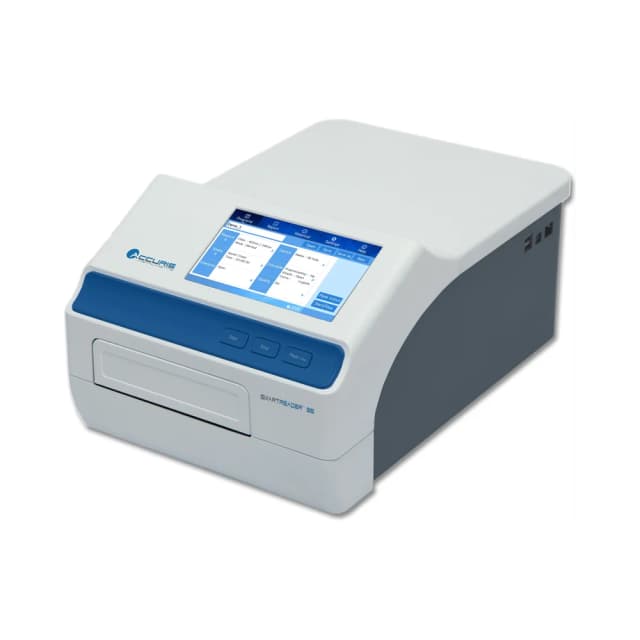
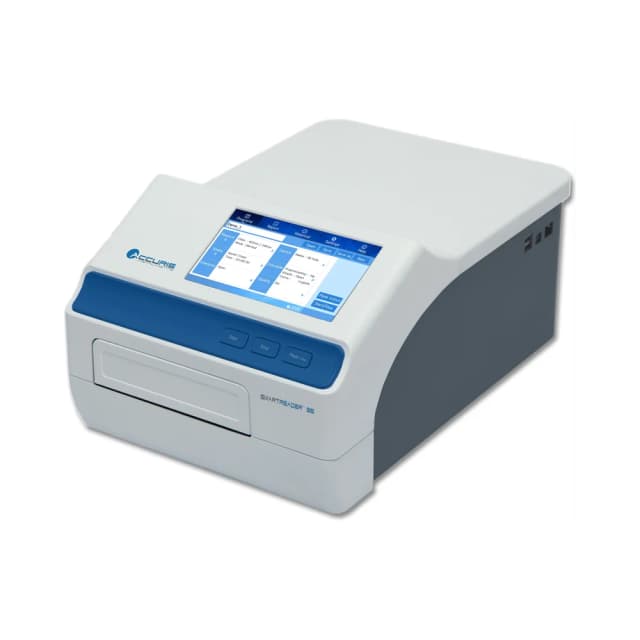
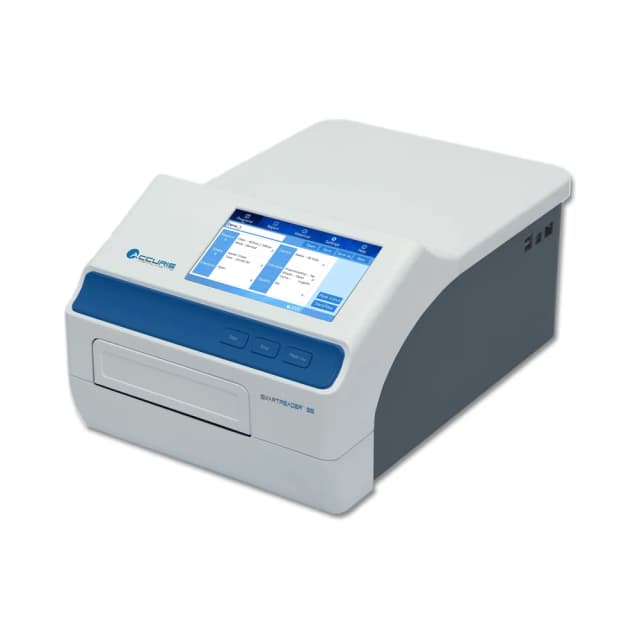
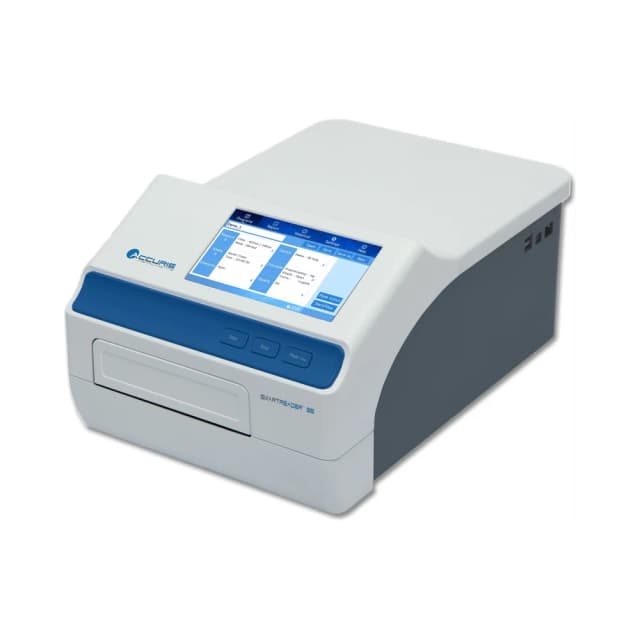
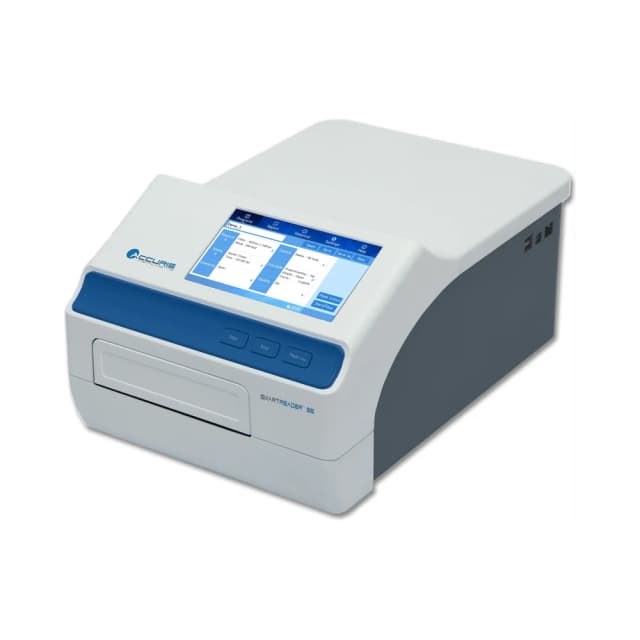
The MR9600 is the entry-level visible-spectrum microplate reader in the Accuris SmartReader line, designed for the 96-well-format absorbance assays that dominate routine clinical, research, and educational lab workflows. Where the MR9610 adds UV capability down to 200 nm and the MR9620 adds fluorescence and luminescence on top, the MR9600 covers the visible-wavelength absorbance workflows (ELISA, protein quantitation in the visible range, cell-density, kinetic enzymology) at a meaningfully lower price point. This is the spec for labs whose primary workflow doesn't require UV (no nucleic-acid quantitation at 260 nm) but does need reliable, daily-use 96-well absorbance.
Voltage options: This unit can be ordered with European voltage requirements (230V/50Hz). Contact us to order.
Key Specifications
| Measurement mode | Visible-spectrum absorbance |
| Plate format | 96-well (primary supported format) |
| Light source | Xenon flash lamp |
| Detector | Photodiode |
| Wavelength range | 340 to 750 nm; four standard filters included (405, 450, 492, 630 nm); filter wheel holds up to 8 filters |
| Bandwidth, accuracy | Accuracy at 450 nm: +/-0.005 Abs (0 to 2.0 Abs), +/-1% (2.0 to 3.0 Abs), +/-1.5% (3.0 to 4.0 Abs); precision CV <= 0.2% (0 to 3 Abs); read-out range 0.000 to 4.000 Abs, resolution 0.001 Abs |
| Power input | 115 V (MR9600) or 230 V (MR9600-E): discrete variants |
Application Profile
ELISA in 96-well format across the standard chromogenic substrates, TMB at 450 nm, OPD at 492 nm, ABTS at 405 nm. The 96-well plate format and visible-spectrum range cover the vast majority of routine immunoassay workflows in clinical research and quality-control labs.
Protein quantitation in the visible range. BCA assay (562 nm), Bradford assay (595 nm), Lowry assay (750 nm), all sit in the visible spectrum and run on the MR9600 without needing UV capability.
Cell-density (OD600) monitoring for bacterial and yeast cultures in microplate format, growth-curve studies, primary microbiology screening, and routine culture-density checks.
Kinetic enzyme assays in the visible range. Time-course substrate-conversion measurements where the reaction generates or consumes a visible-wavelength absorbance.
Microplate-format colorimetric assays. Glucose oxidation, peroxide-detection systems, and any colorimetric readout that doesn't require the UV portion of the spectrum.
Educational and teaching laboratories. The MR9600's lower price point (vs MR9610 / MR9620) makes it an accessible instrument for biology, biochemistry, and biotechnology teaching labs running routine ELISA and protein-quant assays.
Design Architecture
Xenon flash lamp as the light source, same flash-lamp class as the higher-tier SmartReader instruments, providing consistent intensity across the visible spectrum and long lifespan vs continuous arc sources.
Photodiode detector. Wide dynamic range and low noise across the visible spectrum. Optimal for absorbance reads; fluorescence and luminescence sensitivity require the PMT detector in the MR9620.
96-well primary format. Engineered around the 96-well microplate as the dominant routine-assay format. For 384-well or 6-well work, the MR9610 / MR9620 handle multiple plate formats.
On-instrument operation. Touchscreen or button-driven (consult current brochure for exact UI) for direct protocol programming and read launch without requiring a tethered PC.
MR9600-T variant adds incubation capability, useful for kinetic assays at controlled temperature (37 °C cell-based work, kinetic enzymology). The base MR9600 is ambient-temperature only.
Frequently Asked Questions
What measurement mode does the MR9600 use? Visible-spectrum absorbance in the 96-well plate format, using a xenon flash lamp and photodiode detector.
Can the MR9600 read UV assays like A260 nucleic-acid quantitation? No. The MR9600 covers the visible spectrum only; for UV down to 200 nm step up to the MR9610.
What is the difference between the MR9600 and MR9600-T? The MR9600-T adds incubation capability for kinetic and temperature-controlled assays; the base MR9600 is ambient-temperature only.
What assays does the MR9600 support? Visible-range ELISA (TMB 450 nm, OPD 492 nm, ABTS 405 nm), protein quantitation (BCA 562 nm, Bradford 595 nm, Lowry 750 nm), OD600 culture density, and visible-range kinetic enzyme assays.
Does the MR9600 need a tethered PC? No. It offers on-instrument operation; the optional MR9600-PC software adds PC-based data management.
Ordering & Configuration
Standard configuration. The MR9600 ships with the instrument, 115 V power cord, operator's manual, and packaging materials (retain for service shipments).
Voltage variants:
- MR9600: 115 V plug (this SKU)
Variant with incubation:
- MR9600-T: adds incubation capability for kinetic and temperature-controlled assays
Compatible accessories:
- MR9600-PC: SmartReader PC Software for data management
- MR9600-TP: Thermal printer for on-instrument result printout
- MR9600-PA: Extra paper rolls for the thermal printer (4-pack)
- MR9600-CAL: Calibration plate (verifies absorbance accuracy across spectrum)
- MR9600-340 / -370 / -380 / -405 / -415 / -420 / -450 / -470 / -492 / -510 / -520 / -532 / -540 / -546 / -560 / -562 / -570 / -578: Filter sets at specific wavelengths for fixed-wavelength assay workflows (each sold separately)
Use the quote request to specify: voltage and plug type, whether incubation capability is needed (drives MR9600 vs MR9600-T selection), filter-cartridge specification per intended assays, calibration-plate inclusion, PC software requirement, and training services.
Warranty: Manufacturer's standard Accuris warranty applies. Service, calibration validation, and lamp replacement through the Accuris service network.
SmartReader 96 vs UV-capable readers: if 100 % of workflow is visible-wavelength assays (ELISA, BCA, Bradford, OD600) and no nucleic-acid quantitation is needed, the MR9600 is the right pick. If the workflow includes any A260 / A280 nucleic-acid work, step up to the MR9610 for UV capability. For multi-mode (absorbance + fluorescence + luminescence), step up to MR9620. The MR9600's price advantage is only relevant if the UV portion of the spectrum is genuinely outside the lab's workflow.