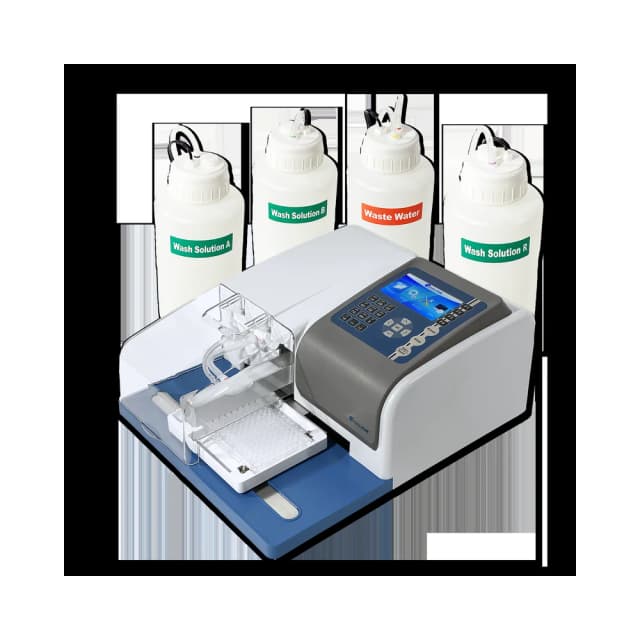
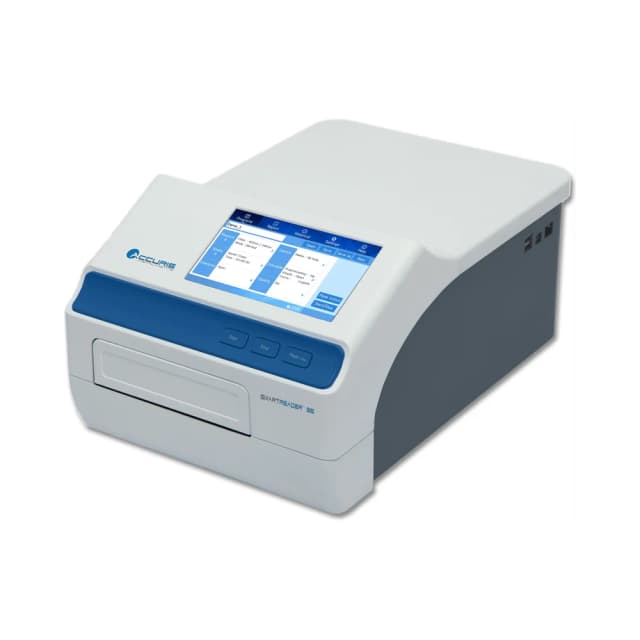
The SmartWasher™ 96 is a fully automated microplate washer for 96-well plates, engineered as the wash-step companion to the Accuris SmartReader™ 96 microplate reader (and other microplate-format readers from popular suppliers). Microplate washing is the bottleneck step in ELISA and most microplate-format immunoassay workflows: between binding incubations and signal-development, the plate has to be washed multiple times to remove unbound reagent, and the wash quality directly determines assay sensitivity and CV. The MW9600 automates that step with 0.1 mm aspiration-needle position accuracy and ≤ 1 µL residual liquid per well, sufficient to remove the variability that hand-washing or vacuum-manifold washing introduces.
Voltage options: This unit can be ordered with European voltage requirements (230V/50Hz). Contact us to order.
Key Specifications
| Plate format | 96-well (full plates, partial plates, strip wells) |
| Plate-bottom geometry accepted | Flat, U, V, or C bottom |
| Wash heads | 1 × 8-channel or 1 × 12-channel (sold separately) |
| Aspiration-needle position accuracy | 0.1 mm |
| Residual liquid per well | ≤ 1 µL after aspiration |
| Washing volume range | 50 – 2,000 µL in 50 µL increments |
| Dispensing accuracy | ≤ 2 % at 300 µL |
| Soaking & shaking time | 1 second to 99 minutes per step |
| Shaking speed | Slow / medium / fast |
| Bottle capacity | 4 × 2.5 L (2 wash bottles + 1 rinse + 1 waste) |
| Liquid-level sensors | On all bottles (alerts low wash/rinse, full waste) |
| Auto-rinse | Primes dispensing tube and wash heads to prevent cross-contamination |
| On-board protocols | Up to 100 stored, recallable; transferable between machines via USB flash drive |
| Display | 4.3-inch LCD with keypad |
| Spill containment | Beveled spill well at wash area; transparent acrylic shield over wash zone |
| Power input | Universal voltage |
Application Profile
ELISA and immunoassay washing. The dominant microplate-washer use case, between primary-antibody, secondary-antibody, and substrate steps in an ELISA, the plate is washed 3–5 times per cycle. The MW9600 automates each wash cycle (dispense → soak → shake → aspirate) with consistent residual-liquid removal, eliminating well-to-well variability that compromises ELISA reproducibility.
Cell-based assay washing. Adherent-cell microplate-format assays where cells are stained with fluorescent antibodies and washed before imaging. The SmartWasher's aspiration-needle precision (0.1 mm) avoids disturbing cells while removing unbound reagent.
Magnetic-bead-on-plate workflows. Some magnetic-bead chemistries are run in 96-well format with the plate seated on a magnet. The MW9600 handles the wash-buffer additions and aspirations between binding/elution steps without operator intervention.
Multi-protocol shared-use environment. 100 stored protocols + USB-transferable protocol files mean a shared instrument can host the standard wash protocols for every assay the lab supports, recallable by name.
SmartReader 96 + SmartWasher 96 integrated workflow. Marketed as the "perfect partner" for the SmartReader 96, the two instruments together cover the wash-then-read sequence that defines microplate-format immunoassay workflow. Transition between wash and read is a single plate-handoff step.
Design Architecture
0.1 mm aspiration-needle positioning: the precision spec that determines wash quality. At well-bottom curvature on U / V / C-bottom plates, sub-mm needle positioning means consistent residual-liquid removal without scraping the well bottom (which would damage adherent cells or remove plate-coating).
≤ 1 µL residual liquid per well. The standard reproducibility metric for automated microplate washers. Hand-washing and vacuum-manifold washing typically leaves 5–20 µL residual; that variance translates directly into ELISA CV.
Auto-rinse before each protocol. Primes the dispensing tube and wash heads with the current wash buffer. It prevents cross-contamination between protocols using different buffers (e.g., switching from PBS-Tween to TBS-Tween between assays).
8- vs 12-channel wash heads. The 8-channel head services 96-well plates in row orientation (12 wash cycles per plate); the 12-channel head services in column orientation (8 wash cycles per plate). Both are sold separately and chosen per the workflow's plate orientation. Some workflows install both and swap between them.
Liquid-level sensors on all 4 bottles. Wash bottles alert when low (avoid running dry mid-cycle); waste bottle alerts when full (avoid overflow). Important for unattended overnight runs or when the instrument is shared across users.
Beveled spill well + transparent acrylic shield. Spill-containment design, if a wash buffer overflow occurs (overflow valve failure, plate misalignment), liquid drains to the beveled well rather than across the bench. Transparent shield lets the operator visually monitor the wash cycle.
4.3-inch LCD with keypad. All wash-cycle parameters (dispense volume, suction time, soak duration, shake cycles, shaking speed) are programmed via the keypad. 100-protocol on-board memory + USB transfer covers protocol portability across multiple instruments.
Soaking & shaking flexibility (1 second to 99 minutes). Long-soak protocols (e.g., overnight crystal-violet wash) and short-shake-only protocols both run on the same instrument.
Frequently Asked Questions
What plate formats does the MW9600 handle? 96-well plates (full, partial, or strip wells) with flat, U, V, or C bottoms.
How thorough is the wash? Aspiration-needle position accuracy of 0.1 mm and ≤ 1 µL residual liquid per well.
Are the wash heads included? No, the 8-channel and 12-channel wash heads are sold separately; choose per plate orientation.
How many protocols can it store? Up to 100 on-board, recallable and transferable between machines via USB flash drive.
What is the companion instrument? The MR9600 SmartReader 96 microplate reader, for the wash-then-read ELISA workflow.
Ordering & Configuration
Standard configuration. The MW9600 ships with the instrument, 4 × 2.5 L bottles (2 wash + 1 rinse + 1 waste), liquid-level sensor harnesses, beveled-spill-well kit, transparent acrylic shield, 115 V power cord, operator's manual, and packaging materials. Wash heads are sold separately. Order 8-channel and/or 12-channel per workflow plate orientation.
Compatible accessories:
- 8-channel wash head (separate SKU)
- 12-channel wash head (separate SKU)
- Replacement wash bottles, waste bottles, and tubing per usage cycle
Voltage variants:
- MW9600: 115 V plug (this SKU)
Companion instrument:
- MR9600 SmartReader 96: paired microplate reader for the wash-then-read ELISA workflow
Use the quote request to specify: voltage and plug type, wash-head selection (8-channel, 12-channel, or both), companion-reader inclusion (MR9600 SmartReader 96 if not already in lab), wash-bottle and tubing inventory, training, and lead time.
Warranty: Manufacturer's standard Accuris warranty applies.
Microplate-washer selection note: automated microplate washers vary widely in aspiration-needle precision (the spec that governs residual-liquid removal). The MW9600's 0.1 mm precision and ≤ 1 µL residual is competitive with mid-tier dedicated immunoassay-platform washers at meaningfully lower price point, the right pick for institutional-research, clinical-research, and core-facility ELISA workflows where dedicated walk-away ELISA platforms are over-spec'd.