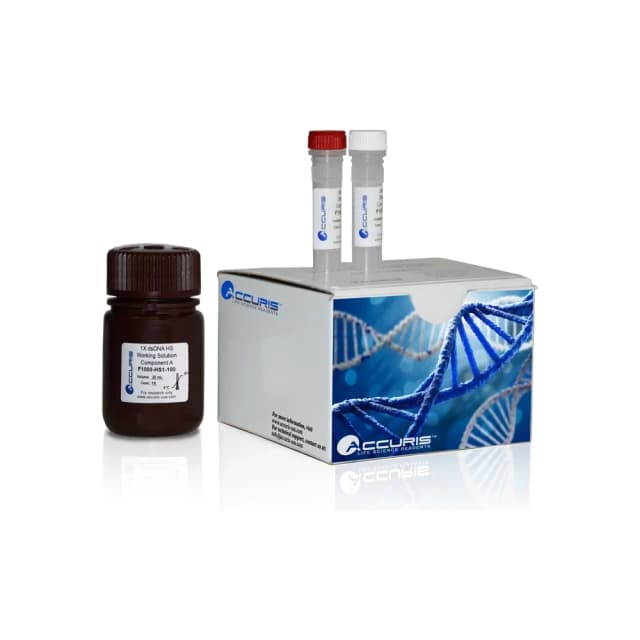
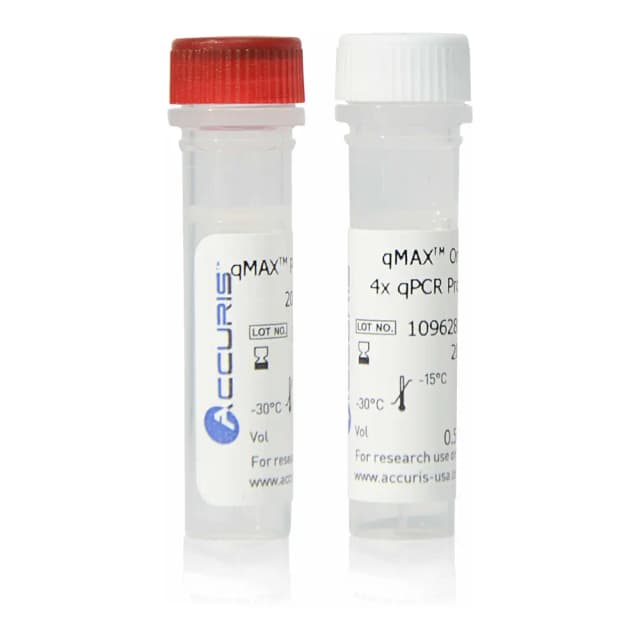
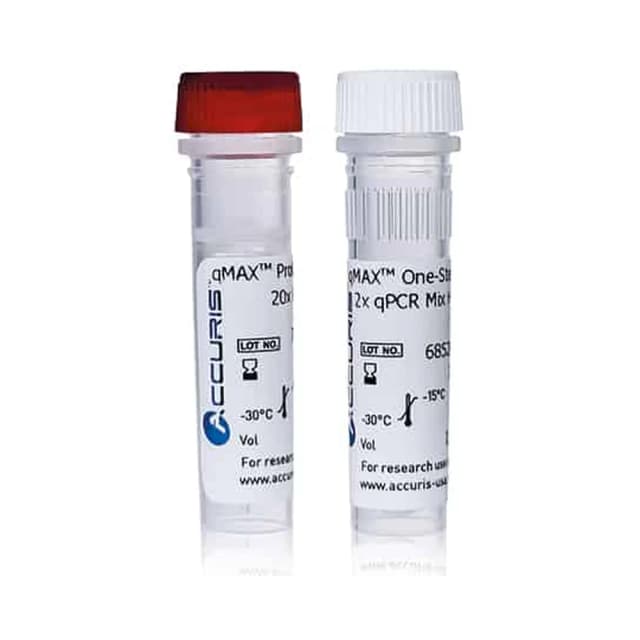
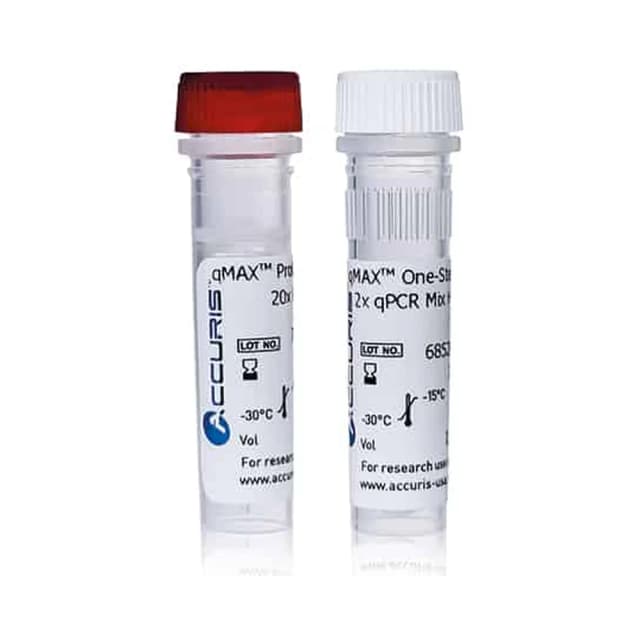
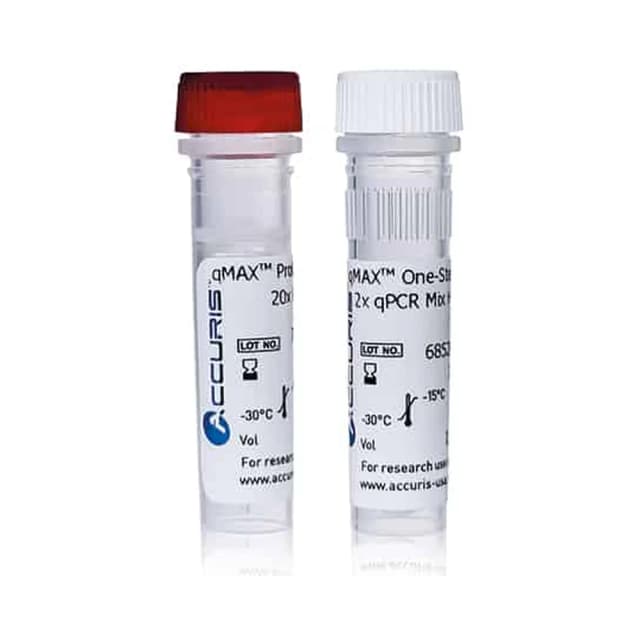
The PR2122-N-50BLK is the 5,000-reaction bulk pack of the Accuris qMAX Multiplex One-Step RT-qPCR Kit in the No ROX formulation, a probe-based one-step RT-qPCR kit optimized for high-multiplex panels (3+ targets per reaction). Distinct from the single-target qMAX Probe kit (PR2121) by the multiplex-optimized buffer chemistry that supports unmatched multiplexing performance per the Accuris brochure. The kit pairs the same MMLV reverse transcriptase + Hot Start Taq polymerase + RNase inhibitor architecture as the rest of the qMAX family, but with chemistry tuned for the cross-channel signal balance that multiplex panels require.
Key Specifications
| SKU | PR2122-N-50BLK |
| Type | One-Step RT-qPCR Kit (multiplex probe-based detection) |
| Reactions per pack | 5,000 reactions (bulk pack: 1 × 50 mL master mix per universe label hint) |
| Detection chemistry | Multiplex probe-based real-time qPCR / TaqMan, Scorpions, molecular beacon probes with cross-channel balance optimization |
| Multiplexing capacity | 3+ targets per reaction (designed for high-multiplex panel chemistry) |
| ROX formulation | No ROX. Compatible with cyclers that don't require ROX normalization |
| Workflow | One-step (RNA template → multiplex qPCR result in one tube, one reaction setup) |
| Reverse transcriptase | Thermostable MMLV-derived |
| Polymerase | Accuris Hot Start Taq with antibody-mediated hot-start activation |
| RNase inhibitor | Included in optimized buffer |
| Cycler compatibility (No ROX) | Bio-Rad CFX, Roche LightCycler, and similar real-time cyclers that don't require ROX normalization |
| Pack size context | 50BLK = bulk-discount pack |
Multiplex vs Single-Target Probe: Why a Dedicated Kit
The qMAX Multiplex kit's chemistry differs from the single-target qMAX Probe kit (PR2121) in:
- Cross-channel signal balance. Multiplex panels run multiple probes (multiple fluorophores, multiple channels) in the same reaction; the buffer chemistry is tuned to maintain consistent amplification efficiency across all channels
- Probe-probe interaction tolerance. Multiplex chemistry tolerates the inevitable probe-probe interactions that occur when multiple probes share reaction volume
- Primer-dimer suppression at higher multiplex. More primer pairs in the reaction increase primer-dimer artifact risk; the multiplex chemistry is tuned to suppress this
Pick the PR2122 Multiplex kit when running 3+ target panels where the dedicated multiplex chemistry's cross-channel balance matters. For 1-2 target workflows, the PR2121 Probe kit handles low-level multiplex without the multiplex-specific chemistry premium. For very high-multiplex panels or workflows requiring concentrated reagent (lower per-reaction volume), see the PR2124 Multiplex 4X kit.
ROX Variant Family: N / L / H
Same convention as the rest of the qMAX family:
| Suffix | ROX level | Compatible cyclers |
| N (this SKU) | No ROX | Bio-Rad CFX, Roche LightCycler, Eppendorf Mastercycler RealPlex |
| L | Low ROX | Applied Biosystems QuantStudio (newer), Stratagene Mx3000P/Mx3005P |
| H | High ROX | Applied Biosystems 7000/7300/7500/7900HT (older) |
Workflow & Application
One-step multiplex RT-qPCR workflow. RNA template + kit master mix + multiple gene-specific primer sets + multiple probes (operator-supplied) in a single tube → reverse transcription + multiplex qPCR amplification + multi-channel real-time detection in one thermal cycler run.
Multiplex panel design. Typical multiplex panels run 3-5 targets per reaction across 3-5 cycler channels (FAM, HEX/VIC, Cy5, Texas Red, Cy5.5 for 5-color cyclers). Probe-fluorophore selection should match the cycler's available channels.
Hot-start polymerase + multiplex chemistry. The combined chemistry supports high-multiplex panel reliability at the bulk-pack scale.
Application Profile
Multi-pathogen detection panels. Clinical-research and surveillance labs running multiplex pathogen panels (respiratory viral panels, sexually transmitted infection panels, gastrointestinal pathogen panels) where multiple targets per reaction reduce per-sample cycler time.
Multiplex gene-expression panels. Gene-expression profiling workflows that quantify multiple genes per reaction (housekeeping gene + target genes; pathway-related gene panels).
Allele-specific or splice-variant multiplex. Workflows that quantify multiple variants of a gene in a single reaction.
Diagnostic-research-grade multiplex RT-qPCR. Translational research workflows that validate multiplex panels for downstream diagnostic development.
Bulk-pack institutional procurement. Labs running >5,000 multiplex RT-qPCR reactions per year benefit from the bulk-pack per-reaction discount.
Ordering & Configuration
Storage & handling. Per kit instructions: typical multiplex RT-qPCR master mix storage at −20 °C with limited freeze-thaw cycle tolerance.
Cycler compatibility verification. Critical at order: confirm the lab's real-time cycler platform requires the No ROX formulation AND has sufficient channel capability for the multiplex panel design.
Probe procurement separately. This kit supplies the master mix; multiplex probe sets are operator-supplied per the workflow's specific panel design.
Confirm at quote: real-time cycler platform and ROX requirement, multiplex panel design and channel count, expected workflow throughput, shipping conditions (cold-chain), and lead time.
Warranty: Per Accuris Life Science Reagents standard kit warranty terms. Confirm at quote.
qMAX RT-qPCR family: multiplex variants:
- PR2122-N-50BLK (this product): Multiplex, 5,000 reactions
- PR2124: Multiplex 4X (concentrated, higher-multiplex panels)
- PR2121: Single-target Probe (low-level multiplex acceptable)
- PR2120: SYBR Green (cost-effective single-target)
Pick PR2122 for 3+ target multiplex panels where dedicated multiplex chemistry's cross-channel balance matters.