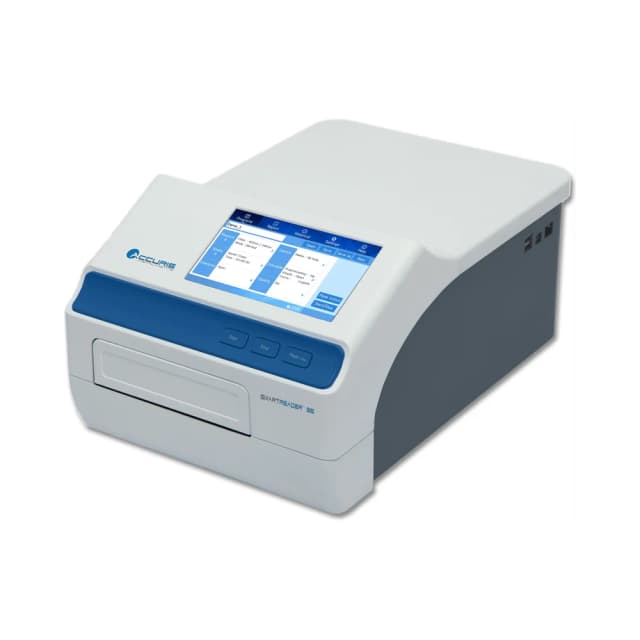
The MR9610 is the UV-Vis microplate reader in the Accuris SmartReader line, full 200–1,000 nm absorbance spectrum, 6-well through 384-well plate-format support, xenon flash lamp, and photodiode detection. The MR9610's defining feature against the MR9600 (visible-only at higher wavelengths) is UV capability down to 200 nm, required for nucleic-acid quantitation at 260 / 280 nm, UV-spectrum protein characterization, and any workflow whose target absorbance lies in the UV region. Where the MR9620 multimode adds fluorescence and luminescence on top, the MR9610 is the focused absorbance instrument for labs whose primary workflow is UV-Vis microplate-format spectroscopy.
Voltage options: This unit can be ordered with European voltage requirements (230V/50Hz). Contact us to order.
Key Specifications
| Measurement mode | UV-Vis Absorbance |
| Wavelength range | 200 – 1,000 nm |
| Plate formats | 6-well through 384-well |
| Light source | High-energy xenon flash lamp |
| Detector | Photodiode |
| Wavelength accuracy | ± 2 nm |
| Wavelength repeatability | 0.2 nm |
| Bandwidth (FWHM) | > 2.5 nm |
| Absorbance range | 0.0 – 4.0 OD |
| Resolution | 0.0001 OD |
| Power input | AC 100–240 V universal, 50–60 Hz |
Application Profile
Nucleic-acid quantitation in microplate format. A260 / A280 reads for DNA and RNA concentration and purity assessment, with the option of full-spectrum scan for 260/230 ratio (organic-contamination check) and characterization of unusual absorbance profiles.
ELISA and absorbance immunoassays across the standard chromogenic substrates, TMB at 450 nm, OPD at 492 nm, ABTS at 405 nm. Microplate-format throughput supports 96-well or 384-well batch ELISAs.
Protein quantitation. BCA assay (562 nm), Bradford assay (595 nm), Lowry assay (750 nm), direct A280 protein concentration, biuret, and other absorbance-based protein quantitation methods.
UV-spectrum protein and dye characterization. Full 200–1,000 nm scanning supports protein-conjugate characterization, dye-loading determination, and spectrum-quality assessments where a fixed-wavelength read is insufficient.
Cell-culture density (OD600) reads. Microplate-format bacterial and yeast culture monitoring for growth-curve studies and primary-screening workflows.
Enzyme kinetics in microplate format. Time-course absorbance reads for Michaelis-Menten kinetics, enzyme-inhibition screens, and kinetic substrate-conversion measurements.
Design Architecture
High-energy xenon flash lamp as the excitation source. Flash-lamp lifespan significantly exceeds continuous xenon arc sources at equivalent intensity, important for an instrument specified for daily institutional use.
Photodiode detector. Wide dynamic range (0.0001 OD resolution across the 0.0–4.0 OD specified range), fast response, low noise across the 200–1,000 nm spectrum. The photodiode is optimal for absorbance, fluorescence and luminescence sensitivity require the PMT detector that's in the MR9620 multimode.
Full UV capability to 200 nm. The defining hardware difference vs the MR9600 (which is visible-spectrum only). Required for nucleic-acid 260 nm reads and any sub-340 nm absorbance work; optical components (lamp, filter cartridges, plate-bottom material assumed UV-compatible) are specified accordingly.
Wavelength scanning in 1 nm steps. Full 200–1,000 nm scans for spectrum characterization beyond fixed-wavelength reads.
On-instrument touchscreen operation. Protocols and reads programmed directly on the instrument; PC connection for data export.
Microplate format flexibility. 6-well through 384-well plate compatibility means the same instrument handles low-throughput method development and high-throughput primary screening.
Frequently Asked Questions
What wavelength range does the MR9610 cover? Full UV-Vis absorbance from 200 to 1,000 nm, with ±2 nm wavelength accuracy and a 0.0–4.0 OD absorbance range at 0.0001 OD resolution.
How does the MR9610 differ from the MR9600? The MR9600 is visible-spectrum only; the MR9610 adds full UV capability down to 200 nm, which is required for nucleic-acid quantitation at 260/280 nm and any sub-340 nm absorbance work.
What plate formats and detector does it use? 6-well through 384-well plates, a high-energy xenon flash lamp source, and a photodiode detector optimized for absorbance.
When should I step up to the MR9611 or MR9620? Step to the MR9611 to add a single-sample cuvette port, or the MR9620 multimode to add fluorescence and luminescence detection.
What accessories are available? The MR9610-SDP SmartDrop Accessory Plate (microvolume nucleic-acid quant), the MR9610-PC PC software, and the MR9610-CAL calibration plate.
Ordering & Configuration
Standard configuration. The MR9610 ships with the instrument, 115 V power cord, operator's manual, and packaging materials (retain for service shipments).
Voltage variants:
- MR9610: 115 V plug (this SKU)
Compatible accessories:
- MR9610-SDP: SmartDrop Accessory Plate (microvolume nucleic-acid quantitation in microplate format)
- MR9610-PC: SmartReader UV-Vis PC Software
- MR9610-CAL: Calibration plate
Use the quote request to specify: voltage and plug type, SmartDrop accessory plate (if microvolume nucleic-acid quant is part of workflow), PC software requirement, calibration-plate inclusion, and training / on-site validation services.
Warranty: Manufacturer's standard Accuris warranty applies. Service, calibration validation, and lamp replacement available through the Accuris service network.
SmartReader family selection:
- MR9600: 96-well visible-spectrum reader; the entry into the SmartReader line for routine ELISA workflow without UV capability
- MR9610: UV-Vis microplate reader, the standard pick when nucleic-acid quant or sub-340 nm UV reads are part of the workflow
- MR9611: UV-Vis with cuvette port; the MR9610 plus single-sample cuvette workflow
- MR9620: Multimode (absorbance + fluorescence + luminescence); the flagship for cores covering all three detection modes