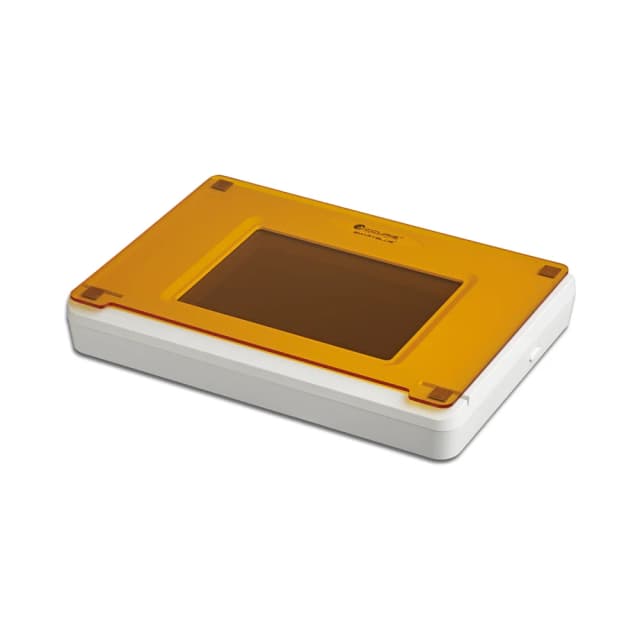
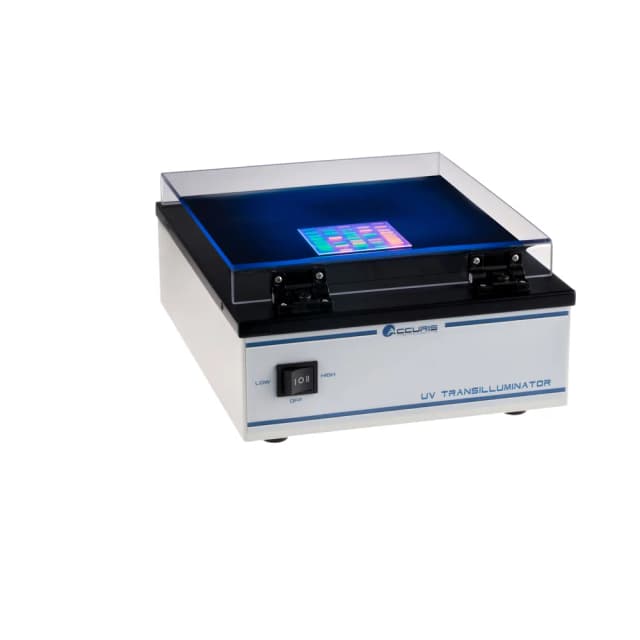
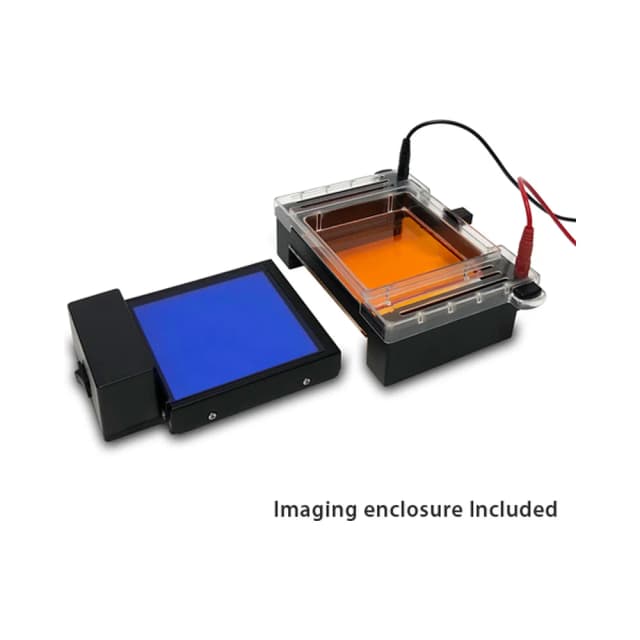
The Accuris SmartBlue Blue Light Transilluminator is a standalone blue-light transilluminator for visualizing DNA bands stained with green fluorescent stains (SmartGlow, SYBR Green, GelGreen, and other 465 nm-excitation chemistries). The SmartBlue uses Uniform Illumination (UI) technology to deliver consistent 465 nm blue-light excitation across the viewing surface, important for downstream documentation where uneven illumination would introduce intensity gradients into the captured gel image. Blue-light excitation does not damage nucleic acids the way UV excitation does, supporting downstream cloning, sequencing, and re-electrophoresis workflows on the same gel.
Voltage options: This unit can be ordered with European voltage requirements (230V/50Hz). Contact us to order.
Key Specifications
| SKU | E4000 |
| Voltage | 115 V |
| Wavelength | 465 nm (visible blue light) |
| Illumination technology | Uniform Illumination (UI): consistent blue-light intensity across viewing surface |
| DNA safety | Does not damage nucleic acids (vs UV which nicks DNA strands) |
| Compatible stains | SmartGlow, SYBR Green, Gel Green, GreenGlo, and other 465 nm-excitation green fluorescent DNA stains |
| Amber filter cover | Two-position cover included (lift to access gel for band-cutting; lower for viewing through orange filter) |
| Replacement amber cover | E4000-AC |
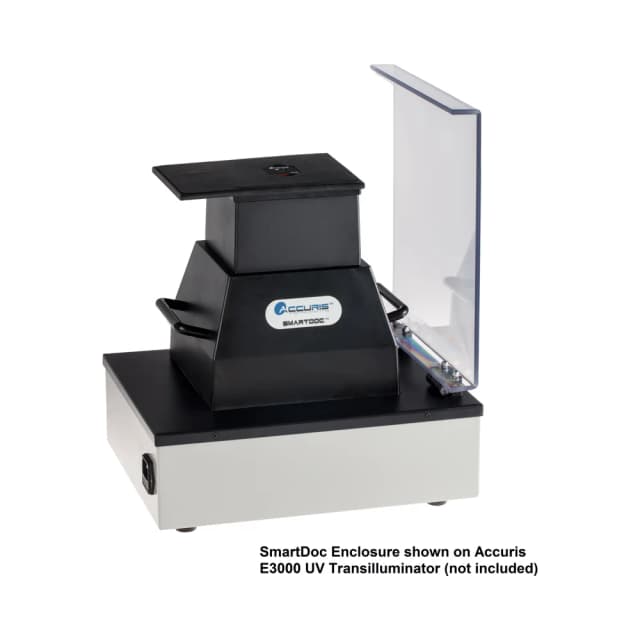
| Smartphone documentation pairing | Compatible with SmartDoc 2.0 imaging enclosure (E5001-SD) for smartphone-camera gel imaging |
| Optional viewing glasses | E4000-VG1 SmartBlue Plus Viewing Glasses (UV + blue-light blocking, ANSI Z87.1 compliant) |
Why Blue Light vs UV
Traditional DNA-band visualization uses UV transilluminators (302 nm midrange UV), the established workhorse for ethidium bromide (EtBr) staining. UV excitation has two well-known limitations:
- DNA damage. Prolonged UV exposure nicks DNA strands, compromising downstream cloning, ligation, transformation, and sequencing workflows on excised bands
- Operator safety. UV exposure is hazardous to skin and eyes, requiring face shields, UV-blocking glasses, and procedural caution
Blue light at 465 nm addresses both:
- No DNA damage. Visible blue light does not nick DNA, supporting downstream molecular workflows on the same gel
- Operator safety. Blue light is in the visible spectrum; while bright, it does not pose the UV-radiation hazard
The trade-off is stain compatibility. Blue light works with green fluorescent stains (SmartGlow, SYBR Green, Gel Green, etc.) but not with EtBr (which requires UV excitation). Modern molecular-biology workflows have largely transitioned away from EtBr toward the safer green-fluorescent alternatives, making blue-light transilluminators the modern default.
Two-Position Amber Filter Cover
The SmartBlue ships with a removable two-position amber filter cover that serves two workflow modes:
| Mode | Amber cover position | Use case |
| Viewing mode | Lowered over the viewing surface | Direct visualization of DNA bands through the orange filter (operator looks down through the cover) |
| Band-cutting mode | Raised / removed | Operator accesses the gel directly for excising target bands for downstream extraction (cloning prep, sequencing prep, fragment isolation) |
The two-position design supports both routine visualization and band-cutting workflows without removing the cover entirely or swapping accessories.
Application Profile
Routine PCR-product visualization. The workhorse application. Stained gels (SmartGlow / SYBR Green / Gel Green) viewed at 465 nm for product confirmation.
Band-excision workflows for downstream cloning. The no-DNA-damage blue-light visualization preserves DNA integrity for ligation / transformation downstream. Use the band-cutting mode (amber cover raised) to excise target bands.
Sequencing-prep gel visualization. Fragment-extraction prep gels for Sanger sequencing or NGS library construction benefit from preserved DNA integrity.
Teaching laboratory DNA electrophoresis. Undergraduate / graduate molecular-biology programs benefit from the safer-than-UV workflow (no UV-eye-protection training overhead, no DNA-damage concerns for student exercises).
Smartphone-camera gel documentation. Pair with the SmartDoc 2.0 imaging enclosure (E5001-SD) for high-resolution smartphone-camera gel image capture without separate gel-doc capital.
Field-deployment workflows. Environmental sampling, agricultural diagnostics, veterinary diagnostics labs benefit from the compact bench-top design.
SmartBlue vs Other Accuris Transilluminator Options
| Transilluminator | Wavelength | Best for |
| E4000 SmartBlue (this product) | 465 nm blue | Green fluorescent stains; DNA-safe workflows |
| E3000 / Accuris UV Transilluminator | 302 nm midrange UV | EtBr, SmartGlow, SYBR® stains (multi-stain compatibility) |
| E3100 (myView Compact UV) | 302 nm midrange UV | Compact UV setups for budget-tier labs |
| E3200: Variable-intensity UV (21 × 26 cm) | 302 nm midrange UV | Large-gel UV workflows with intensity control |
Pick the SmartBlue (E4000) for: green-fluorescent-stain workflows where DNA integrity matters or where operator-safety profile favors blue-light over UV.
Frequently Asked Questions
What wavelength does the SmartBlue (E4000) emit? 465 nm visible blue light, delivered with Uniform Illumination (UI) technology for consistent intensity across the viewing surface.
Which gel stains work with the E4000? SmartGlow, SYBR Green, Gel Green, GreenGlo, and other 465 nm-excitation green fluorescent DNA stains, but not ethidium bromide, which requires UV.
Is blue light safer for DNA than UV? Yes. 465 nm blue light does not nick DNA strands the way UV does, preserving DNA integrity for downstream cloning, ligation, and sequencing on excised bands.
Can the E4000 be used for smartphone gel documentation? Yes. It pairs with the SmartDoc 2.0 imaging enclosure (E5001-SD); the E5001-SDB bundle combines both in one procurement line.
What is the amber filter cover for? The two-position cover lowers for viewing bands through the orange filter and raises for direct access when excising bands for extraction.
Ordering & Configuration
Stain compatibility check at order. Confirm the lab's gel-stain chemistry. If the lab runs EtBr, the SmartBlue is incompatible. Order the E3000 / E3100 / E3200 UV transilluminator family instead. If the lab has transitioned to green-fluorescent stains (SmartGlow / SYBR Green / Gel Green), the SmartBlue is the right pick.
Smartphone-documentation pairing. Labs adding smartphone-camera gel-doc capability should confirm SmartDoc 2.0 imaging enclosure (E5001-SD) inventory or order it alongside the SmartBlue. The SmartBlue is the illumination base; the SmartDoc adds the smartphone-mount + filter enclosure. The E5001-SDB bundled SKU pairs both into a single procurement line.
Confirm at quote: voltage and plug type, gel-stain chemistry (blue-light-compatible vs EtBr), smartphone-documentation pairing, viewing-glasses inventory (E4000-VG1), training requirements, and lead time.
Warranty: Per Accuris standard warranty terms. Confirm at quote.
Accuris SmartBlue family and pairings:
- E4000 (this product): SmartBlue Blue Light Transilluminator 115 V
- E4000-AC: Replacement two-position amber filter cover
- E4000-VG1: SmartBlue Plus Viewing Glasses
- E5001-SD: SmartDoc 2.0 imaging enclosure (smartphone-camera pairing)
- E5001-SDB: Bundled SmartBlue + SmartDoc package
Pick the SmartBlue for green-fluorescent-stain workflows; pair with SmartDoc 2.0 for smartphone-camera gel documentation.