
Buyer's Guide
How to Choose a Centrifuge
A complete centrifuge buying guide, from mini short-spin units to high-capacity floor-standing systems. Learn how to choose by RCF (× g), rotor type, capacity, refrigeration, and safety, then browse real models across every centrifuge class.
How to Choose the Right Laboratory Centrifuge
A centrifuge separates substances by density using rapid rotation, and it is one of the most-used instruments in any life-science, clinical, or industrial lab. Choosing the right one comes down to a short list of questions: how much force (RCF) does your protocol require, what tube or vessel format do you run, do your samples need to stay cold, and how many samples must you process per run?
This guide walks through eight classes of centrifuge, from compact mini spin-downs to high-capacity floor-standing systems, and explains what each is for, the specifications that matter, and the real models we carry. Every model referenced below is a stocked, published product you can browse and quote directly.
Legacy Lab Supplies is an authorized distributor for centrifuge manufacturers including Hermle and Benchmark Scientific. All equipment carries the full manufacturer warranty with our competitive pricing.
RCF vs RPM, and Fixed-Angle vs Swing-Out Rotors
RPM (revolutions per minute) describes how fast the rotor turns. RCF (relative centrifugal force, in × g) describes the actual force applied to your sample and depends on both the speed and the rotor radius. Because a larger rotor produces more force at the same RPM, protocols should specify RCF, set the force your assay needs and let the centrifuge convert to RPM for the installed rotor. Modern units such as the Hermle Z-series display and accept either value.
Fixed-angle rotors hold tubes at a set angle, reach higher speeds and RCF, and produce a compact pellet against the tube wall, the right choice for pelleting cells, bacteria, and nucleic-acid columns. Swing-out (swinging-bucket) rotors let tubes pivot to horizontal during the spin, giving a flat, cleanly layered interface that is ideal for density-gradient separations and blood fractionation. Many universal centrifuges accept both, so a single instrument can cover multiple protocols.
Safety is non-negotiable: always balance opposing tubes by mass, use the correct adapters, and choose a unit with automatic imbalance detection and a lid interlock. For infectious or aerosol-generating samples, select sealable rotors or biocontainment lids and confirm the unit meets a recognized standard such as IEC 61010.
Mini Centrifuges
Mini centrifuges are compact "short-spin" units for quickly collecting sample at the bottom of microtubes and PCR strips. They occupy minimal bench space and are ideal for spinning down condensate, pelleting quick reactions, and general molecular-biology prep where high force is not required. Analog models run at a preset speed, while digital models add programmable speed and time.
Format
Microtubes, PCR strips (rotor-dependent)
Control
Preset (analog) or programmable (digital)
Power
Universal 100–240 V input on most models
Footprint
Compact benchtop / personal
Common Applications
- Quick spin-downs & condensate collection
- PCR strip and tube prep
- Microtube pelleting
- Personal / shared bench use
Shop Mini Centrifuges
Microcentrifuges
Microcentrifuges are high-speed instruments built for 1.5/2.0 mL microtubes and PCR formats used throughout molecular biology, DNA/RNA extraction, spin-column purification, and pelleting. They deliver far higher force than mini centrifuges, with digital speed/time control and rotors optimized for microtube throughput.
Max Speed
Up to 15,000 RPM (e.g. Hermle Z216-M)
Max RCF
Up to 21,379 × g (Hermle Z216-M)
Capacity
Up to 30 × 1.5 / 2.0 mL microtubes (rotor-dependent)
Format
1.5 / 2.0 mL tubes, PCR strips (rotor-dependent)
Common Applications
- DNA / RNA extraction
- Spin-column purification
- Microtube pelleting
- PCR prep & cleanup
Shop Microcentrifuges
Clinical Centrifuges
Clinical centrifuges are benchtop units sized for 10–15 mL blood and specimen tubes, used for serum and plasma separation and routine clinical sample prep. They run at moderate speeds with swing-out or fixed-angle rotors and prioritize simple operation and a small footprint for POL, hospital, and clinical-research benches.
Tube Format
5–15 mL clinical / conical tubes
Rotor Style
Swing-out or fixed-angle (model-dependent)
Typical Capacity
6 × 10 mL, 8 × 15 mL (rotor-dependent)
Use
Serum / plasma separation, specimen prep
Common Applications
- Serum & plasma separation
- Blood fractionation
- Urine sediment prep
- Physician-office & clinical labs
Shop Clinical Centrifuges
Benchtop & Universal Centrifuges
Universal benchtop centrifuges accept interchangeable rotors so one instrument can spin microtubes, conical tubes, plates, and bottles across a wide range of protocols. They bridge the gap between dedicated microcentrifuges and floor-standing units, making them the workhorse choice for shared research and clinical benches.
Speed Range
6,000 RPM (Z206-A) to 16,000 RPM (Z446)
Max RCF
4,427 × g (Z206-A) up to ~26,000 × g (Z446)
Capacity
0.2 mL tubes to 750 mL bottles (rotor-dependent)
Rotors
Interchangeable fixed-angle & swing-out
Common Applications
- Multi-format research workflows
- Cell harvesting
- Protein & nucleic-acid prep
- Shared / core-facility benches
Shop Benchtop & Universal Centrifuges
Refrigerated Centrifuges
Refrigerated centrifuges hold a set temperature throughout the run so heat from rotor friction never degrades temperature-sensitive samples. They are essential for RNA/DNA, protein and enzyme work, and live-cell protocols. Hermle K-series models offer pre-cooling and standstill cooling to keep samples cold before and after the spin.
Temperature Range
-20°C to +40°C (Hermle K-series)
Max Speed
Up to 18,000 RPM (Hermle Z327-K)
Max RCF
Up to 26,328 × g (Hermle Z446-K, angle rotor)
Cooling
CFC-free; pre-cooling & standstill cooling
Common Applications
- RNA / DNA & enzyme work
- Protein purification
- Live-cell processing
- Long or high-speed runs
Shop Refrigerated Centrifuges
High-Capacity Floor-Standing Centrifuges
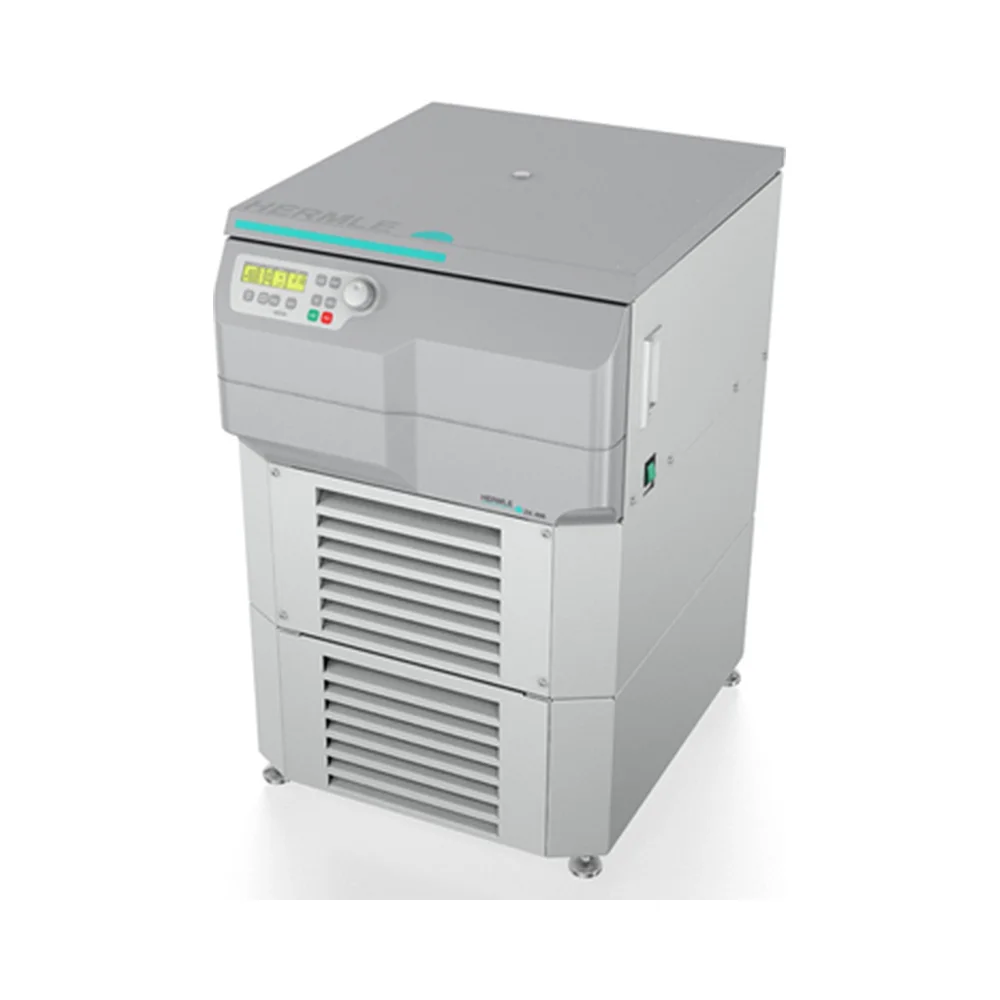
Floor-standing centrifuges deliver the largest tube counts and bottle volumes for high-throughput processing, harvesting liters of culture or spinning many large bottles per run. They free up bench space in exchange for a bigger footprint, higher power requirements, and greater weight, and are typically refrigerated for demanding production and core-facility workflows.
Max Volume
4 × 1,000 mL (Hermle Z496-K)
Max Speed
10,500 RPM (Hermle Z496-K)
Max RCF
16,022 × g (Hermle Z496-K)
Power
Typically 230V; floor-standing footprint
Common Applications
- High-volume cell harvesting
- Large-bottle processing
- Core facilities & production
- Bioprocess & scale-up
Shop High-Capacity Floor-Standing Centrifuges
Microplate Centrifuges
Microplate centrifuges spin standard and deep-well plates to collect liquid at the bottom of wells, remove bubbles, and prep samples for reading. They are a staple of high-throughput and automation workflows where plate-format handling, rather than tube pelleting, is the goal.
Format
Standard microplates; deep-well (with rotor)
Purpose
Well collection, de-bubbling, plate prep
Power
115 V or 230 V (discrete variants)
Accessories
PCR-tube adapters, deep-well-plate rotor
Common Applications
- High-throughput screening prep
- Well liquid collection
- Bubble removal before reading
- Automation workflows
Shop Microplate Centrifuges
Specialty & Industrial Centrifuges
Specialty centrifuges are purpose-built for a specific method rather than general lab prep. Oil-test (OLEUM) centrifuges determine water-and-sediment content in petroleum samples, while filtration (SIEVA) centrifuges use a perforated basket to separate solids from liquids for process and QC applications.
OLEUM Oil-Test
Up to 3,000 RPM / 2,213 × g, 4 × 100 mL
SIEVA-3 Filtration
Up to 10,000 RPM / 7,825 × g, 500 mL basket
Method
Petroleum water/sediment test; solid–liquid filtration
Build
Heavy-duty industrial / process
Common Applications
- Petroleum water & sediment testing
- Solid–liquid filtration
- Process & QC labs
- Industrial separation
Shop Specialty & Industrial Centrifuges
How to Choose: Centrifuge Comparison
Use this comparison to narrow down which centrifuge class matches your application, sample format, and throughput.
| Factor | Mini | Micro | Clinical | Floor-Standing |
|---|---|---|---|---|
| Typical Speed | Preset / low | To 15,000+ RPM | Low–moderate | To ~10,500 RPM |
| Force (RCF) | Low | To 21,000+ × g | Low–moderate | To ~16,000 × g |
| Tube / Volume | Microtubes, PCR strips | 1.5 / 2.0 mL | 5–15 mL clinical | Up to 4 × 1,000 mL |
| Rotor Style | Fixed | Fixed-angle | Swing-out / fixed-angle | Interchangeable |
| Refrigeration | No | Optional (K models) | Usually ambient | Usually refrigerated |
| Best For | Quick spin-downs | Molecular biology | Serum / plasma | High-throughput |
Speed and force figures reference Hermle Z-series models we carry; verify the exact spec your protocol requires on each product page.
Key Specifications Checklist
Before requesting a quote on any centrifuge, verify these specifications against your requirements:
Frequently Asked Questions
What is the difference between RPM and RCF (×g), and which should I use?
RPM (revolutions per minute) measures how fast the rotor spins, while RCF (relative centrifugal force, expressed in × g) measures the actual force applied to your sample. RCF is what matters for a protocol because it accounts for the rotor radius, the same RPM produces a higher force in a larger rotor. Always follow the RCF specified in your protocol and let the centrifuge convert to RPM for the installed rotor. Most modern centrifuges, including the Hermle Z-series, let you set and display either value.
What RCF do I need for common lab applications?
It depends entirely on the application, so always follow your validated protocol. As general guidance: pelleting whole cells and blood fractionation are typically done at low-to-moderate force (roughly hundreds to a few thousand × g), while pelleting bacteria, nucleic-acid spin columns, and microtube protocols often call for higher force (many thousands to 20,000+ × g). Microcentrifuges such as the Hermle Z216-M reach 21,379 × g, and high-speed universal models such as the Z446-K reach up to 26,328 × g with an angle rotor, verify the exact figure your assay requires rather than defaulting to maximum speed.
Do I need a refrigerated centrifuge or is an ambient (non-refrigerated) model enough?
Choose a refrigerated centrifuge when your samples are temperature-sensitive, RNA/DNA work, proteins and enzymes, live cells, and any long or high-speed run where rotor friction heats the chamber. Refrigerated Hermle K-series models hold a set temperature (typically -20°C to +40°C) and offer pre-cooling and standstill cooling so samples stay cold before and after the spin. If you only pellet robust samples at short run times and room temperature is acceptable, an ambient model is smaller, quieter, and less expensive.
What is the difference between a mini, micro, and clinical centrifuge?
Mini centrifuges are compact "short-spin" units for quick spin-downs of microtubes and PCR strips at a fixed or low speed, ideal for collecting condensate or spinning down reactions. Microcentrifuges are high-speed instruments (commonly to 15,000+ RPM and 21,000+ × g) for 1.5/2.0 mL tubes used in molecular biology. Clinical centrifuges are lower-speed benchtop units with swing-out or fixed-angle rotors sized for 10–15 mL blood and specimen tubes, used for serum/plasma separation and routine clinical prep.
When should I choose a fixed-angle rotor versus a swing-out rotor?
Fixed-angle rotors hold tubes at a set angle and are best for pelleting: they generate a compact pellet against the tube wall and reach higher speeds and RCF. Swing-out (swinging-bucket) rotors let tubes pivot to horizontal during the spin, producing a flat, well-defined interface, the right choice for density-gradient separations, blood fractionation, and applications where a clean layer boundary matters. Many universal centrifuges accept both rotor types so one instrument covers multiple protocols.
When do I need to step up to a floor-standing centrifuge?
Step up to a high-capacity floor-standing centrifuge when benchtop tube counts and bottle volumes can no longer keep up with throughput, for example, processing liters of culture or large numbers of 250–1,000 mL bottles per run. Floor-standing units such as the Hermle Z496-K handle 4 × 1,000 mL and free up bench space, at the cost of a larger footprint, higher power requirements (often 230V), and greater weight. For most clinical and molecular labs a benchtop or universal centrifuge is sufficient.
What safety features should a laboratory centrifuge have?
Look for automatic imbalance detection that stops the run if tubes are loaded unevenly, a lid interlock that prevents opening while the rotor spins, and lid-lock that prevents starting with the lid open. For infectious or aerosol-generating samples, choose sealable rotors or biocontainment lids that contain aerosols, and confirm the unit meets a recognized safety standard such as IEC 61010. Always balance opposing tubes by mass and use the correct adapters for your tube size.
Related Guides
Ready to Choose Your Centrifuge?
Whether you need a personal mini centrifuge or a high-capacity floor-standing system, we provide competitive pricing, manufacturer warranties, and expert guidance for every purchase.