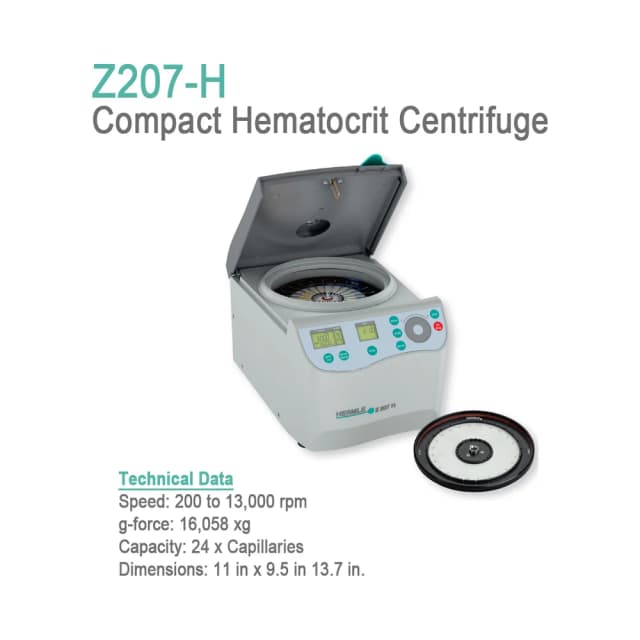
The C3303-6HP is the Sprint 6H Plus, NEW product family of clinical-tier centrifuges with swing-out rotor design at $1,899. KEY DIFFERENTIATOR from the LC-8 family (fixed-angle rotors): swing-out rotor allows tubes to swing horizontal during centrifugation, producing a flat pellet at the tube bottom (vs the angled pellet from fixed-angle rotors). Critical for clinical hematology workflows (packed cell volume / hematocrit measurement, plasma / serum separation) where pellet visibility and aliquot pipetting accuracy depend on flat pellet geometry.
Author confidence note (MEDIUM): No specific Sprint brochure in available corpus. Confirm exact max RPM / RCF, swing-out rotor mechanics, and EU plug variant availability with Benchmark Scientific technical support.
Voltage options: This unit can be ordered with European voltage requirements (230V/50Hz). Contact us to order.
Key Specifications
| SKU | C3303-6HP |
| Type | Sprint 6H Plus Clinical Centrifuge with swing-out rotor |
| Rotor included | 6 × 15 mL swing-out rotor |
| Power | 150 W |
| Voltage | 115 V or 230 V, 50–60 Hz (discrete variants) |
| Plug type | US Plug (this SKU); EU Plug variant: confirm at order |
| Compatible accessory rotor | C3303-1215 (optional 12 × 15 mL rotor, $282) |
| Sister LC-8 family | C3100 / -E ($647), C3200 / -E ($897): fixed-angle rotors |
| List price | $1,899 |
Why a Swing-Out Rotor: Clinical Hematology Workflows
Fixed-angle rotors (LC-8 family) hold tubes at a fixed tilt angle during centrifugation, pellet forms along the tube wall at the rotor angle, not at the tube bottom. Swing-out rotors (Sprint family) let tubes pivot to horizontal during centrifugation, pellet forms flat at the tube bottom as gravity / centrifugal force aligns vertically along tube length.
Flat pellet geometry matters for several clinical workflows: in clinical hematology, packed cell volume (hematocrit) measurement requires a flat cell layer for accurate volume reading; in plasma / serum separation, clean separation between the cell pellet and supernatant requires a flat phase boundary; aliquot pipetting accuracy improves because pipetting supernatant without disturbing the pellet is easier when the pellet is flat at the tube bottom rather than angled along the tube wall; and in density gradient centrifugation, flat layer geometry is critical for layer-based separation (Ficoll, Percoll workflows).
Pick the Sprint 6H Plus (C3303-6HP) when:
- Workflow is clinical hematology, hematocrit / packed cell volume / WBC differential
- Plasma / serum separation workflows
- Density gradient centrifugation (Ficoll / Percoll) and PBMC isolation, flat layer geometry required
- Pharmaceutical / clinical research with clinical sample-prep requirements
Stay with C3100 / C3200 LC-8 family for fixed-angle workflows where flat pellet geometry isn't required, substantial cost saving when fixed-angle is sufficient.
Centrifuge Rotor Type Decision Matrix
| Feature | LC-8 family (fixed-angle) | Sprint 6H Plus (swing-out, this product) |
| Tube position during cycle | Tilted at rotor angle | Horizontal (swing-out) |
| Pellet geometry | Angled along tube wall | Flat at tube bottom |
| Best for | General sample-prep, cell pelleting | Clinical hematology, plasma/serum separation, density gradient |
| List price | $647-$897 | $1,899 |
Application Profile
Clinical hematology. Hematocrit / PCV measurement, WBC differential.
Plasma / serum separation. Clinical chemistry sample-prep.
Density gradient centrifugation. Ficoll-Paque, Percoll layer-based separation.
PBMC isolation. Peripheral blood mononuclear cell isolation workflows.
Pharmaceutical / clinical research. Clinical sample-prep at facility scale.
Multi-investigator clinical / hematology facility. Facility-scale clinical centrifugation.
Method-development workflows with clinical sample-prep protocols.
Frequently Asked Questions
What rotor is included with the C3303-6HP? A 6 × 15 mL swing-out rotor.
What is the difference between a swing-out and a fixed-angle rotor? A swing-out rotor lets tubes pivot to horizontal during the cycle, forming a flat pellet at the tube bottom; a fixed-angle rotor (the LC-8 family) holds tubes tilted, forming an angled pellet along the tube wall.
What workflows need a swing-out clinical centrifuge? Clinical hematology (hematocrit / packed cell volume), plasma / serum separation, density gradient centrifugation (Ficoll / Percoll), and PBMC isolation.
Can the C3303-6HP take a higher-capacity rotor? Yes. The optional C3303-1215 12 × 15 mL rotor ($282) is compatible.
What voltage and power does the C3303-6HP use? 115 V or 230 V, 50–60 Hz, 150 W.
Ordering & Configuration
Confirm voltage and plug type. 115 V / 230 V chassis; confirm EU plug variant with Benchmark Scientific.
Pair with optional 12 × 15 mL rotor (C3303-1215, $282) for higher-throughput workflows beyond the included 6-position rotor.
Plan rotor balance protocols. Swing-out rotors require careful balance (paired tubes opposite each other) for safe operation.
Confirm at quote: voltage / plug type, intended clinical / hematology workflow context, optional rotor pairing, and lead time.
Warranty: Per Benchmark Scientific standard capital-equipment terms.
Centrifuge rotor type: fixed-angle vs swing-out:
- C3100 / C3200 LC-8 family: Fixed-angle rotor for general sample prep
- C3303-6HP Sprint 6H Plus (this product, $1,899): Swing-out rotor for clinical hematology workflows
Pick the Sprint for clinical / hematology / density gradient workflows; sister LC-8 chasses cover general fixed-angle workflows at lower cost.