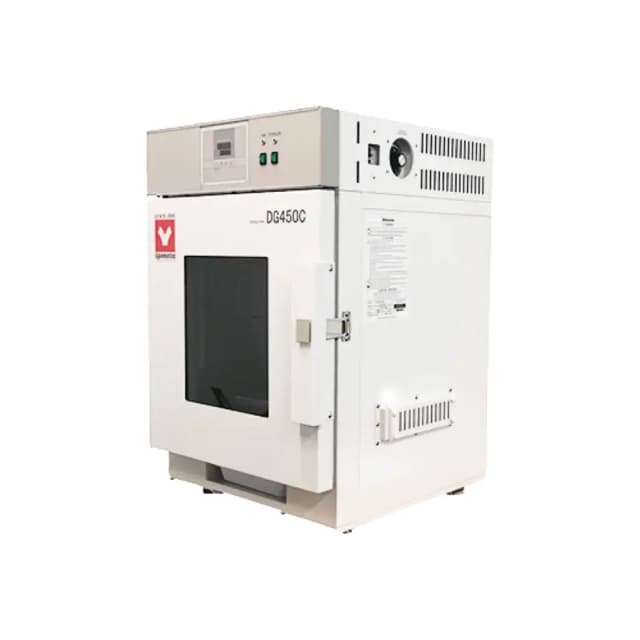
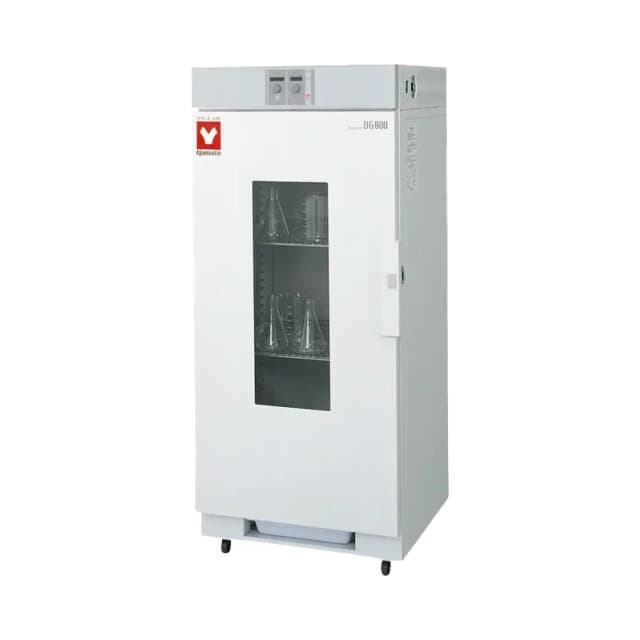
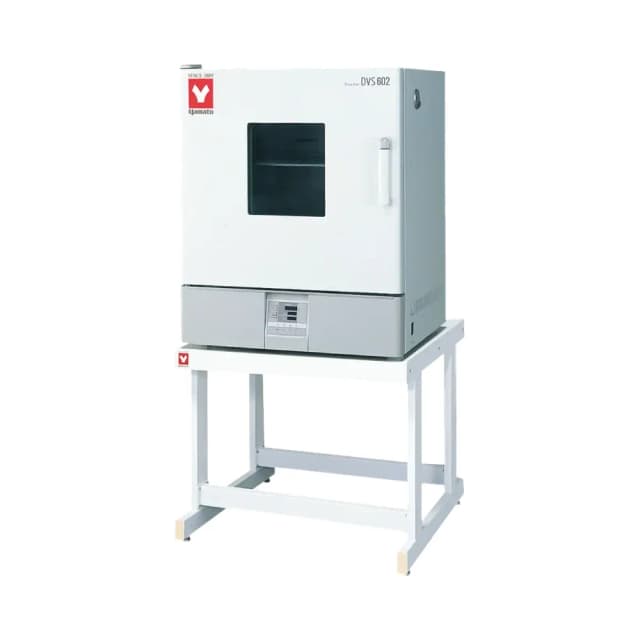
The Yamato DVS-413C is the 220 V, 99 L programmable model of the DVS natural-convection drying-oven family, a constant-temperature oven with a VS4 program controller and an operating range of ambient +5 °C to 260 °C. Mechanically identical to the 115 V DVS-403C, the Yamato DVS-413C serves labs on 220 V single-phase service that need automated ramp/soak recipes for drying, curing, or conditioning. It is the entry-capacity unit in the DVS line.
Key Specifications
| Spec | Value |
| Model (focus) | Yamato DVS-413C (brochure model DVS402, 220 V variant) |
| Type | Programmable natural-convection constant-temperature drying oven |
| Operating temperature range | Ambient +5 °C to 260 °C |
| Temperature control accuracy | ±1 °C (at 260 °C) |
| Temperature distribution accuracy | ±5 °C (at 260 °C) |
| Temperature rise time | Approx. 90 min (ambient +5 °C to 260 °C) |
| Exhaust port | Rotating damper, 20 % opening when closed |
| Heater | SUS pipe heater, 1.2 kW |
| Controller | VS4 program controller |
| Control system | PID heater control by microcomputer |
| Setting method | Digital, dedicated menu keys plus ▼▲ |
| Operation modes | Fixed temperature, program, quick auto-stop, auto-stop, auto-start |
| Sensor | K-thermocouple |
| Observation window | Reinforced glass, 250 × 280 mm |
| Internal dimensions (W×D×H) | 450 × 490 × 450 mm |
| External dimensions (W×D×H) | 560 × 601 × 820 mm |
| Chamber volume | 99 L |
| Weight | Approx. 48 kg |
| Power supply | 220 V, 50/60 Hz (export variant of the 100 V base model) |
| Included | 2 trays (15 kg/tray load), instruction manual, warranty card |
Application Profile
The 99 L DVS-413C suits drying, curing, and conditioning workflows that benefit from repeatable, hands-off temperature-time programs, staged drying of samples and media, multi-step cure schedules for coatings and adhesives, and standardized conditioning protocols up to 260 °C. The reinforced-glass observation window lets operators monitor a load without opening the door and disturbing the setpoint.
Why the Yamato DVS-413C fits programmable gravity work
Program operation is the differentiator: the VS4 controller runs multi-segment ramp/soak recipes with quick auto-stop, auto-stop, and auto-start modes, so a defined cycle repeats identically shift after shift. As a natural-convection oven it moves air gently through a rotating exhaust damper, better distribution than the fixed DX ovens (±5 °C at 260 °C) while keeping fan-free airflow. Where forced-air uniformity is essential, step to the DKN/DF forced-convection lines. (See oven-temperature-uniformity.)
Frequently Asked Questions
What temperature range does the Yamato DVS-413C reach? Ambient +5 °C to 260 °C, with ±1 °C control accuracy and ±5 °C distribution accuracy at 260 °C.
How does the DVS-413C differ from the DVS-403C? Same 99 L programmable oven; the DVS-413C is the 220 V version and the DVS-403C is the 115 V-nominal (100 V AC) version.
Is the DVS-413C programmable? Yes. It uses a VS4 program controller with multi-step program operation plus fixed-temperature, quick auto-stop, auto-stop, and auto-start modes.
How large is the chamber? 99 L (450 × 490 × 450 mm internal), with two 15 kg-rated trays and a 250 × 280 mm reinforced-glass window.
Is it forced-air or natural convection? It is a natural-convection oven with a rotating exhaust damper; there is no circulation fan.
Ordering & Configuration
quote-based. The DVS-413C is a capital programmable drying oven sold through a quote. At quote we confirm your 220 V single-phase service and connection, the program profile you need (target soak temperatures and ramp/soak steps ≤ 260 °C), tray loading, and the 560 × 601 × 820 mm footprint with exhaust routing. Warranty terms are confirmed with the quote, and lead time is provided at quotation. Request a quote to configure the DVS-413C.
DVS programmable natural-convection family: DVS-403C/413C (99 L, this unit) → DVS-603C/613C (162 L). Choose the DVS line over the fixed-mode DX ovens when you need automated ramp/soak recipes; step to a forced-convection oven when tight uniformity across a full load is the priority.