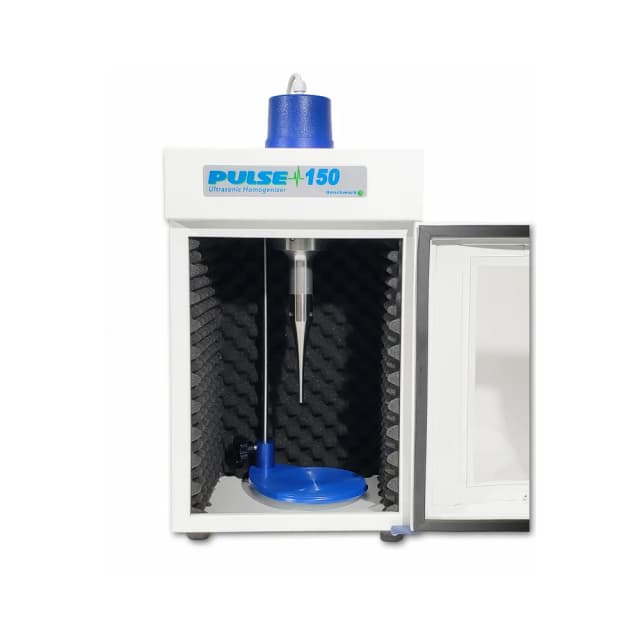
The DP0650 Pulse 650™ is a 650-watt ultrasonic homogenizer for cell disruption, DNA shearing, emulsification, and other ultrasound-driven sample-preparation workflows. Where bead-mill homogenization (e.g., the BeadBlaster line) processes batches of samples in parallel via mechanical bead impact, ultrasonic homogenization processes a single sample at a time via cavitation, high-frequency ultrasonic waves create and collapse microbubbles in the sample, generating localized shear and shockwave forces sufficient to lyse cells, shear DNA to defined fragment sizes, or emulsify immiscible liquids. The Pulse 650 ships complete with controller, 6 mm horn, motorized stand, and soundproof enclosure, everything needed for operation, including the noise-reduction enclosure (ultrasonic horns produce significant acoustic noise that requires environmental shielding).
Voltage options: This unit can be ordered with European voltage requirements (230V/50Hz). Contact us to order.
Key Specifications
| Power | 650 W |
| Sample volume range | 0.1 mL to 500 mL (depends on horn size) |
| Included horn | 6 mm (for processing samples 10–100 mL) |
| Available horn sizes (sold separately) | 2 mm, 3 mm, 6 mm (included), 8 mm, 12 mm: six total covering 0.1 mL to 500 mL volume range |
| Display / control | Large touch screen for operating parameters |
| Operating modes | Continuous + Pulsed operation; programmable pulse ratios |
| Alarms | Over-temperature, over-load, no-load, time expiration |
| Probe placement | Remote-controlled motorized lift |
| Sample visualization | Lighted chamber with large front panel for viewing |
| Decontamination | UV-C chamber sterilization function |
| Form factor | Stackable: low-profile controller + soundproof enclosure stack to save bench space |
Application Profile
Cell disruption for protein extraction from bacterial, mammalian, plant, and yeast cells. Ultrasonic cavitation is the preferred method for samples where shear-sensitive enzymes need to be released without bead carryover or where the workflow downstream requires a clean lysate without bead residue.
DNA / RNA shearing. NGS library prep often requires DNA shearing to defined fragment sizes (typically 100–1,000 bp); the Pulse 650 with appropriate pulse ratio and time produces tunable fragment-size distributions. Pulse parameters set on the touchscreen.
Emulsification. Producing stable oil-in-water or water-in-oil emulsions for formulation development, drug-delivery research, and food-science workflows. Ultrasonic emulsification produces smaller and more uniform droplet sizes than mechanical or magnetic-stirrer mixing.
Particle deagglomeration. Breaking up agglomerated particles in suspensions, nanoparticle dispersion, colloidal-suspension preparation, slurry conditioning.
Liposome and nanoparticle preparation. Sonication is the standard method for sizing down liposomes and producing small unilamellar vesicles; the Pulse 650 with appropriate horn and pulse ratio supports this directly.
Sample preparation for analytical chemistry. Forced extraction of analytes from solid matrices (soil samples, food samples) prior to analytical workup.
Design Architecture
650 W ultrasonic generator. Sufficient power for the 500 mL upper-volume spec when paired with a 12 mm horn. Lower-power sonicators (the DP0150 Pulse 150 at 150 W) are limited to smaller sample volumes (0.1–50 mL typical).
Six interchangeable horns (2 mm to 12 mm). Horn size is matched to sample volume. The brochure provides the volume-vs-horn-size table. The 6 mm horn (included with the DP0650) covers 10–100 mL; 2 mm horn for 0.1–10 mL ranges; 8 mm and 12 mm for 100 mL and 500 mL ranges. Mismatched horn-to-volume produces inefficient cavitation.
Continuous + Pulsed operation with programmable pulse ratios. Pulsed operation allows heat dissipation between bursts, important for thermolabile samples (RNA, intact protein complexes) that would otherwise overheat during continuous sonication. Pulse parameters (on-time, off-time, total cycles) are touchscreen-programmable.
Alarm system. Four protective alarms. Over-temperature (sample heating exceeds set-point), over-load (probe encountering high impedance from solid debris or wall contact), no-load (probe not immersed), and time expiration (run complete). The over-load alarm is critical for protecting the horn and generator from damage when the probe contacts vessel walls.
Remote-controlled motorized lift for probe placement. The operator positions the sample vessel, then uses the remote control to lower the probe to the appropriate immersion depth without manual probe handling. It improves reproducibility and reduces operator exposure to ultrasonic energy.
Soundproof enclosure with lighted chamber. Ultrasonic operation produces high-frequency acoustic noise that would otherwise require operators to wear hearing protection or limit nearby workspace use. The enclosure brings noise to lab-environment-acceptable levels and includes interior lights for sample visualization through the large front panel.
UV-C chamber sterilization. Between uses, the chamber is decontaminated with UV-C lights, important for cross-contamination prevention when the same instrument processes multiple sample types or biological samples in sequence. Ultrasonic horns are difficult to thermally sterilize (the horn-tip surface can be damaged by autoclaving); UV-C surface decontamination is the practical alternative.
Stackable controller + enclosure saves bench space, the low-profile controller stacks beneath the soundproof enclosure for a smaller bench footprint than side-by-side mounting.
Frequently Asked Questions
Q: What sample volume range does the Pulse 650 handle? A: 0.1 mL to 500 mL, depending on horn size, six horns (2, 3, 6, 8, 12 mm) cover the full range; the included 6 mm horn covers 10–100 mL.
Q: What's included with the DP0650? A: The ultrasonic generator/controller, 6 mm horn, motorized stand with remote-controlled lift, and soundproof enclosure with lighted chamber and UV-C sterilization.
Q: How does it differ from the DP0150 Pulse 150? A: The DP0150 is a 150 W sonicator for smaller volumes (0.1–50 mL); the 650 W DP0650 handles up to 500 mL and produces tighter droplet/vesicle size distributions for emulsification and liposome work.
Q: Why does it need a soundproof enclosure? A: Ultrasonic horns produce significant acoustic noise; the enclosure brings it to lab-acceptable levels and includes interior lighting for sample visualization.
Q: How is the horn decontaminated between uses? A: Via the UV-C chamber sterilization function. Ultrasonic horns can be damaged by autoclaving, so UV-C surface decontamination is the practical alternative.
Ordering & Configuration
Standard configuration (complete operating setup): the DP0650 ships with the Pulse 650 ultrasonic generator + controller, the included 6 mm horn (for the 10–100 mL sample range), the motorized stand with remote-controlled lift, the soundproof enclosure with lighted chamber and UV-C sterilization, a 115 V power cord, and the operator's manual.
Optional horns (sold separately): a 2 mm horn for 0.1–10 mL samples, a 3 mm horn for very small volumes, an 8 mm horn for 100 mL+ samples, and a 12 mm horn for 500 mL upper-volume work.
Voltage: the DP0650 is 115 V (this SKU). Family alternative: the DP0150 Pulse 150, a 150 W lower-power sonicator, is appropriate for smaller-volume samples (0.1–50 mL typical) where 650 W is over-spec'd.
Use the quote request to specify: voltage, additional horn sizes per intended sample-volume range (the included 6 mm horn covers 10–100 mL; for sample volumes outside that range, order the appropriate horn), training (one-day on-site typical for first-time sonicator install; horn handling and noise-safety training), and lead time.
Warranty: Manufacturer's standard Benchmark Scientific warranty applies.
DP0650 vs DP0150 selection: the DP0150 Pulse 150 (150 W) is the right pick for small-volume single-sample workflows (0.1–50 mL) where 650 W is over-spec'd. The DP0650 Pulse 650 (this product) is the right pick for larger-volume work (samples up to 500 mL) and for emulsification or liposome work where the higher power produces tighter droplet/vesicle size distributions.