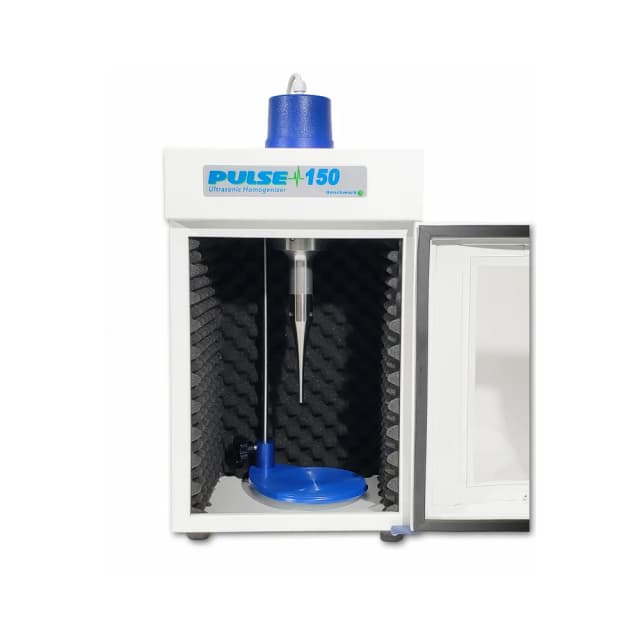
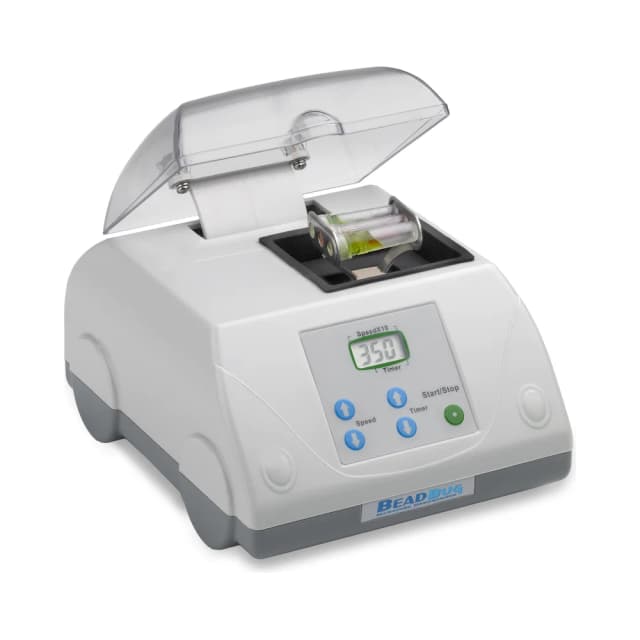
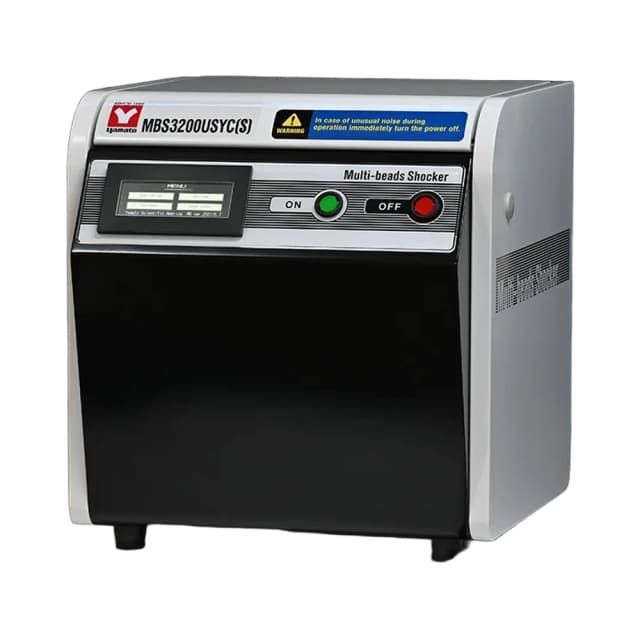
The DP0150 is the Pulse 150 UltraSonic Homogenizer, Benchmark Scientific's probe-sonicator homogenization platform at $3,766. NEW PRODUCT FAMILY: ultrasonic homogenization, high-frequency acoustic cavitation disrupts cell membranes / tissue at the probe tip, providing a chemistry-free alternative to bead-mill (D2400 family) and rotor-stator workflows. Universal-input chassis (120 V / 60 Hz or 240 V / 50 Hz in a single SKU; no separate -E variant).
Author confidence note (MEDIUM): No specific Pulse 150 brochure in available corpus. Confirm exact wattage rating, ultrasonic frequency (kHz), supported probe diameter range, sample volume range per probe, autoclave compatibility, and operating modes (continuous / pulsed / temperature-controlled) with Benchmark Scientific technical support.
Voltage options: This unit can be ordered with European voltage requirements (230V/50Hz). Contact us to order.
Key Specifications
| SKU | DP0150 |
| Type | Ultrasonic / probe-sonicator homogenizer |
| Voltage | 120 V / 60 Hz or 240 V / 50 Hz (universal-input single SKU) |
| Compatible probe horns | DP0150-2 (2 mm, $377), DP0150-3 (3 mm, $377), DP0150-6 (6 mm, $377), DP0150-8 (8 mm, $377) |
| NOT compatible | DP0150-10 (10 mm) and DP0150-12 (12 mm). Universe explicitly states "fits DP0650 only" despite DP0150- prefix |
| List price | $3,766 |
Why an Ultrasonic Homogenizer
Ultrasonic homogenization transmits high-frequency acoustic energy through a probe horn into the sample. Acoustic cavitation (micro-bubble formation and collapse at the probe tip) generates localized shear forces that disrupt cell membranes, tissue, and cellular debris. The mechanism complements (and contrasts with) bead-mill homogenization:
| Feature | Pulse 150 (this product, ultrasonic) | D2400 BeadBlaster (bead-mill) |
| Mechanism | Acoustic cavitation at probe tip | Bead impact within tube |
| Sample format | Open beaker / tube: probe immersed | Sealed tube with beads |
| Sample volume | Probe-diameter-dependent (µL to mL+) | Tube-format (200 µL – 5 mL) |
| Sample throughput | Single-sample per cycle | 24 / 48 / 96 sample parallel |
| Cross-contamination risk | Higher (open-vessel, probe wash between samples) | Low (sealed-tube workflow) |
| Heat generation | High (cooling in ice-bath required) | High (heat-sensitive: refrigerated -R variant) |
| Best for | Single-sample / small-batch / large-volume | High-throughput parallel small-volume |
Pick the Pulse 150 (DP0150) when:
- Workflow is single-sample-at-a-time at variable sample volume
- Open-vessel / beaker format matches the workflow (vs sealed-tube bead-mill)
- Cell-disruption for protein / DNA / RNA extraction at flexible sample scale
- Tissue-disruption for histology / molecular biology sample prep
- Method-development workflows where probe-diameter flexibility (2 / 3 / 6 / 8 mm) is needed
Step up to a higher-power Pulse chassis (e.g., DP0650, $$$; confirm with Benchmark Scientific) for larger sample volumes (the DP0150-10 and DP0150-12 horns are documented for "30-300 mL" and "50-500 mL" respectively, fitting DP0650 only).
Probe Horn Selection: DP0150 Family
The Pulse 150 chassis accepts four probe horns at $377 each. Probe-diameter selection drives sample-volume range, cavitation intensity, and processing efficiency:
| Horn | Diameter | Typical sample scale | List |
| DP0150-2 | 2 mm | Microliter scale (µL; small-volume) | $377 |
| DP0150-3 | 3 mm | Sub-mL to mL scale | $377 |
| DP0150-6 | 6 mm | mL to ~10 mL scale | $377 |
| DP0150-8 | 8 mm | ~5–30 mL scale | $377 |
Match probe diameter to sample volume. Undersized probes deliver insufficient cavitation power for larger samples; oversized probes risk over-disruption / sample heating at small volumes.
Frequently Asked Questions
Q: Which probe horns are compatible with the DP0150 Pulse 150? A: Four horns at $377 each, DP0150-2 (2 mm), DP0150-3 (3 mm), DP0150-6 (6 mm), and DP0150-8 (8 mm). The 10 mm (DP0150-10) and 12 mm (DP0150-12) horns fit the DP0650 chassis only, despite the DP0150- prefix.
Q: How does the Pulse 150 differ from a bead-mill homogenizer like the D2400? A: The Pulse 150 uses acoustic cavitation at an immersed probe tip in an open beaker or tube, processing a single sample per cycle; the bead-mill D2400 uses bead impact inside sealed tubes and processes 24/48/96 samples in parallel.
Q: Does the DP0150 require an ice bath? A: Sample cooling (typically an ice bath) is recommended. Ultrasonic processing generates substantial heat, and cooling preserves heat-sensitive analytes during processing.
Q: What voltage does the DP0150 use? A: It is a universal-input single SKU rated 120 V / 60 Hz or 240 V / 50 Hz. A 230 V / 50 Hz configuration can be ordered by special order.
Ordering & Configuration
Plan ice-bath / sample-cooling workflow. Ultrasonic processing generates substantial heat; sample-cooling (typically ice-bath) preserves heat-sensitive analytes during processing.
Plan probe-cleaning protocol. Open-vessel ultrasonic introduces cross-contamination risk between samples; probe wash between samples is required.
Confirm probe-horn pairing at quote. Probe diameter must match intended sample-volume range.
Confirm at quote: voltage / plug type, probe-horn diameter pairing, intended sample-volume range, sample-cooling workflow, probe-cleaning protocol, and lead time.
Warranty: Per Benchmark Scientific standard capital-equipment terms.
Pulse 150 ultrasonic homogenizer:
- DP0150 (this product): Pulse 150 universal-input chassis ($3,766)
- DP0150-2 / -3 / -6 / -8: Probe horns at $377 each (Pulse 150 compatible)
- DP0150-10 / -12: 10 mm / 12 mm horns fit DP0650 only (different chassis); see those pages for DP0650 chassis pairing detail.
Pick the Pulse 150 for single-sample-at-a-time ultrasonic / probe-sonicator cell-disruption and tissue-homogenization at flexible sample volume scale.