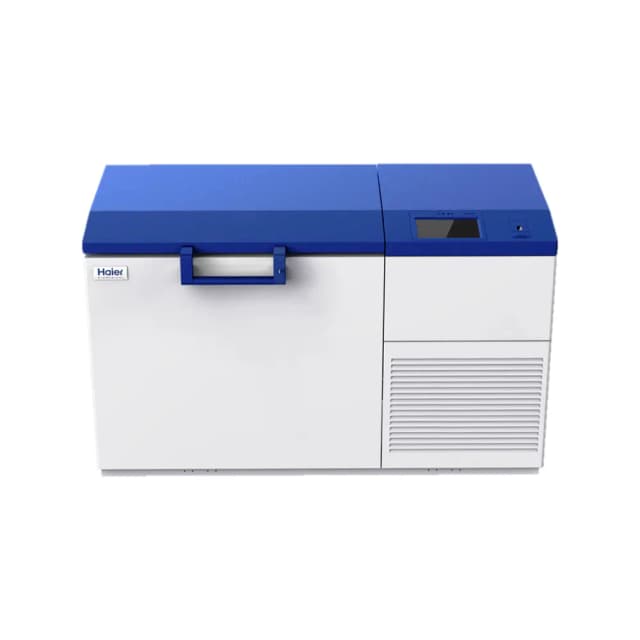
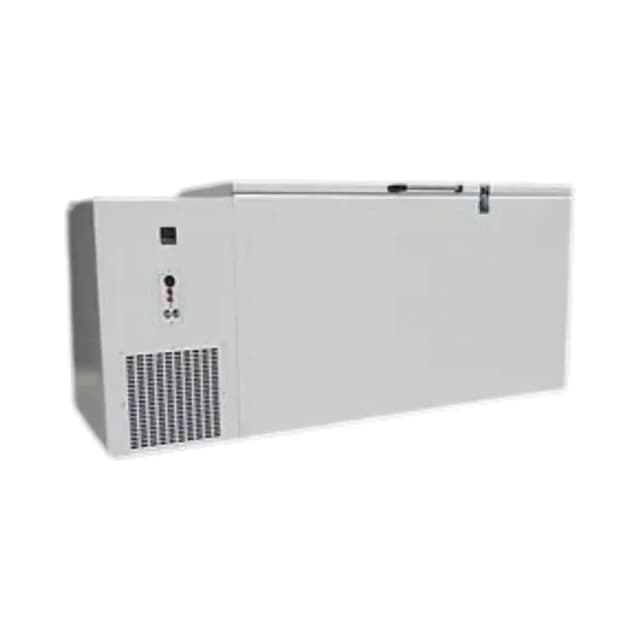
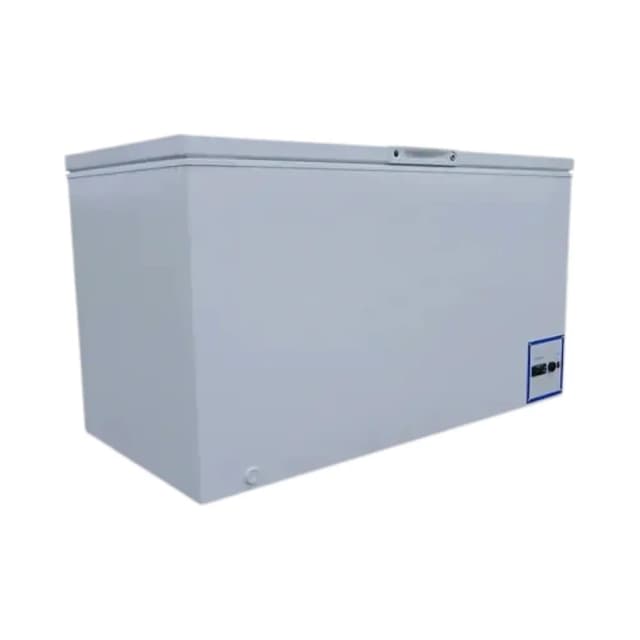
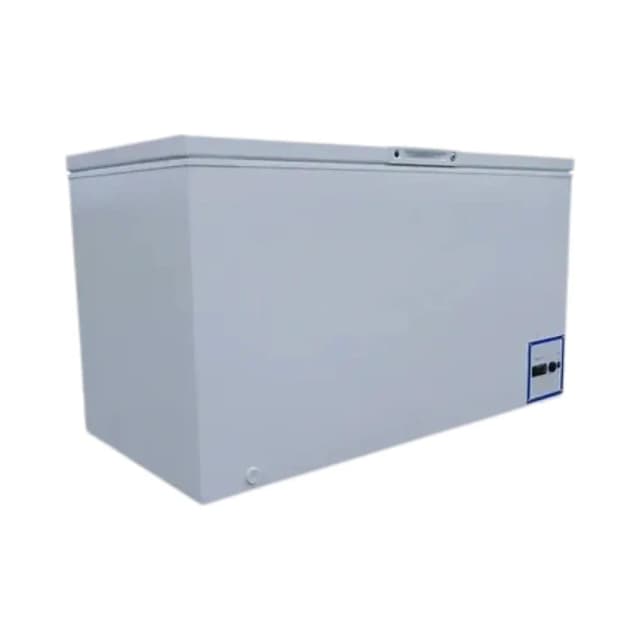
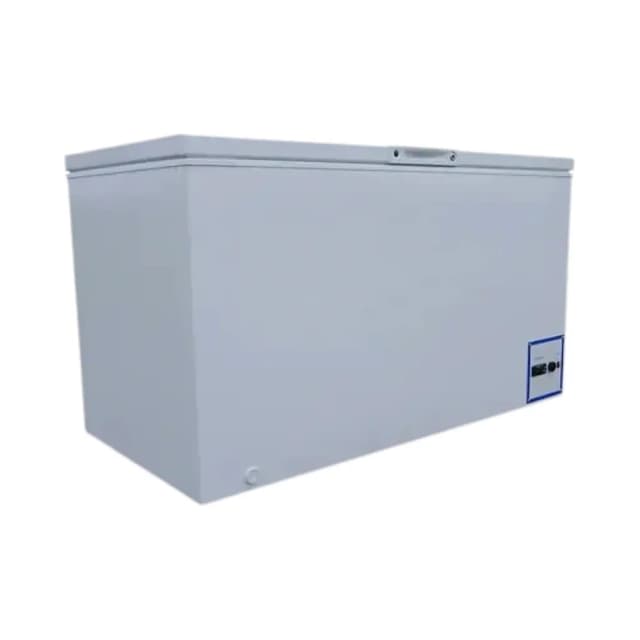
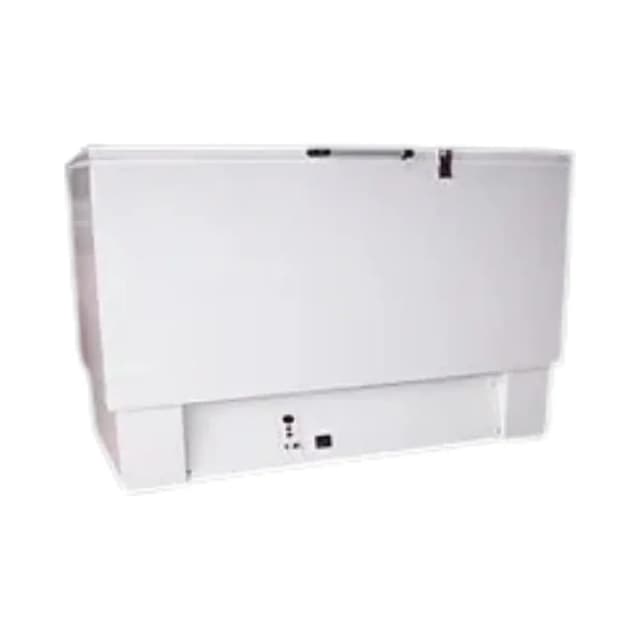
The Haier DW-150W209A is a −150°C cryogenic chest freezer that holds samples in the deep mechanical-cryo range without liquid nitrogen consumables, giving cell banks, stem-cell programs, and long-term biorepositories an LN₂-free path to ultra-deep storage. A dual-compressor, 4-stage cascade hydrocarbon system reaches a −150°C cooling performance with a temperature range of −140°C to −150°C and ±5°C uniformity, all inside a 209 L (7.4 cu ft) chest cabinet certified to UL.
Key Specifications
| Model | DW-150W209A |
| Cabinet type | Chest |
| Cooling performance | −150°C |
| Temperature range | −140°C to −150°C |
| Temperature uniformity | ±5°C at −150°C setpoint |
| Refrigeration | Dual-compressor, 4-stage cascade, HC refrigerant |
| Capacity | 209 L / 7.4 cu ft |
| Rack capacity | 12 racks / 144 two-inch boxes |
| Controller / display | Microprocessor, LCD touchscreen |
| Sound level | 55 dB(A) |
| Power supply | 208–230 V / 60 Hz |
| Max power | 2000 W |
| Inner doors | 2 |
| Backup | LN₂ backup optional |
| Certification | UL |
| List price | $32,000 |
Application Profile
Storing viable cells, master and working cell banks, and vaccine seed stocks below the glass-transition temperature of water (roughly −136°C) demands the deep-cryo band that ordinary −86°C ULT freezers cannot reach. The DW-150W209A is built for exactly that gap: it operates mechanically at −150°C, so a facility can hold cryogenic inventory without piping, filling, or accounting for evaporating liquid nitrogen. That matters because LN₂ dewars carry asphyxiation and burn risk, consume a recurring gas budget, and require oxygen monitoring, all avoided here.
The 100% hydrocarbon refrigerant system has effectively zero global-warming potential, and the LBA-blown polyurethane foam keeps the environmental footprint low while the pressure controller automatically manages system pressure to protect operation across a 10°C–32°C ambient. A rear 25 mm porthole accepts independent monitoring probes, and casters plus leveling feet make placement and validation straightforward.
Design Architecture
Sample safety is layered. The freezer raises alarms for high/low temperature, power failure, door ajar, hot condenser, low battery, sensor error, high ambient temperature, high/low voltage, and start-up delay, with a USB interface, remote alarm contacts, a 5V power port, and standard RS-485 for integration into a facility monitoring system. An optional LN₂ backup can hold temperature through an extended power event. Twelve freezer racks organize up to 144 two-inch boxes across two inner doors, keeping the chest footprint dense without sacrificing retrieval order.
Frequently Asked Questions
What temperature does the DW-150W209A reach? It operates in the −140°C to −150°C range with a −150°C cooling performance, and holds ±5°C uniformity at the −150°C setpoint.
Does it need liquid nitrogen to run? No. It reaches −150°C mechanically with a dual-compressor cascade system. An LN₂ backup is available as an option for power-loss protection, but LN₂ is not required for normal operation.
How many samples does it hold? The 209 L chest holds 12 freezer racks, equivalent to 144 two-inch cryo boxes.
What power does it require? 208–230 V, 60 Hz, drawing up to 2000 W, on a UL-certified system.
How loud is it? Noise-reduction design keeps it at 55 dB(A).
Ordering & Configuration
The DW-150W209A is a capital purchase: request a quote for current pricing, freight, and installation planning. As a cryogenic chest unit it ships on a pallet and benefits from a documented siting and validation plan. Backed by Haier Biomedical's manufacturer warranty; confirm current warranty terms and lead time with your quote.
Choose the DW-150W209A when your program needs true deep-cryo (−150°C) storage but wants to retire the cost, hazard, and monitoring burden of liquid-nitrogen dewars. Step down to a −86°C upright (the DW-86L series) only if your samples are stable at −80°C; step to LN₂ vapor-phase storage only if you need below −150°C.
This configuration adds a built-in LN₂ (liquid-nitrogen) backup system that holds sample-safe temperatures during a power or refrigeration interruption.