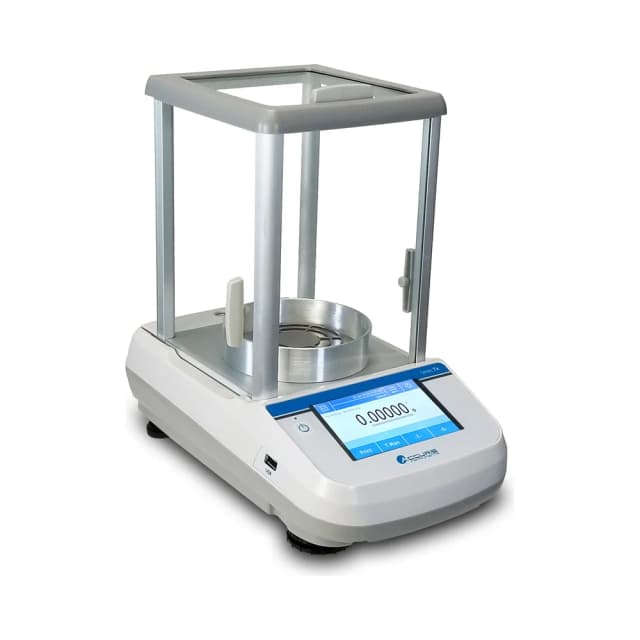
The W3100A-120 is the internal-calibration variant of the Accuris Analytical Balance, same 120 g capacity and 0.0001 g (0.1 mg) readability as the W3100-120 sister SKU, but with built-in auto-calibration using an internal calibration weight on a programmable schedule. The internal-calibration mode reduces the calibration-workflow burden vs external-calibration alternatives (no need to maintain external calibration-weight inventory, no operator-driven calibration-routine workflow); it also ensures consistent calibration across operators (the instrument auto-calibrates to a defined schedule regardless of which operator is using it).
Voltage options: This unit can be ordered with European voltage requirements (230V/50Hz). Contact us to order.
Key Specifications
| SKU | W3100A-120 |
| Voltage | 115 V (North American outlet) |
| Capacity | 120 grams |
| Readability | 0.0001 g (0.1 mg) |
| Calibration mode | Internal (built-in auto-calibration on programmable schedule) |
| External-calibration sister | W3100-120 (external calibration, $2,219) |
| Capacity sister (larger) | W3100A-210 (210 g, internal calibration) |
| Internal-calibration premium vs external | +$135 (~6% premium) |
| List price | $2,354 |
External vs Internal Calibration: Why Two Variants
The Accuris W3100 family ships with both external-calibration and internal-calibration options at each capacity tier:
| Variant | Calibration mode | Workflow burden | Use case |
| W3100 series (W3100-120 / W3100-210) | External (operator-driven with traceable weights) | Higher (maintain calibration-weight inventory, run periodic calibration routine) | Established QM workflows with calibration-weight inventory |
| W3100A series (W3100A-120 (this product), W3100A-210) | Internal (built-in auto-calibration) | Lower (instrument auto-calibrates to programmable schedule) | Multi-operator labs, labs without dedicated calibration-weight inventory, simplified QM workflow |
Internal-calibration advantages:
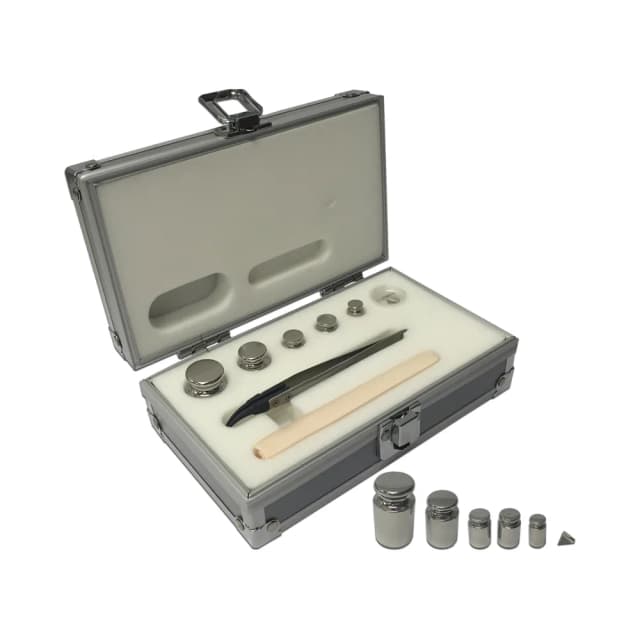
- No external calibration-weight inventory required. Eliminates the cost and storage burden of NIST-traceable Class F1/E2 weights
- Consistent calibration across operators. Auto-calibration runs on schedule regardless of operator
- Reduced training burden. Operators don't need calibration-routine training (the instrument handles it)
- Consistent calibration documentation. Auto-calibration logs to instrument memory, exportable for QM documentation
External-calibration advantages:
- Lower acquisition cost. $135 less than the internal-calibration variant
- External weight verification. Labs that prefer external-weight verification as part of their QM workflow can apply the same weight-verification process to multiple instruments
- Calibration-weight workflow already established. Labs with existing calibration-weight inventory don't need to convert workflow
Pick the W3100A-120 (internal calibration) when workflow simplicity, multi-operator consistency, and reduced calibration-weight burden matter. Pick the W3100-120 (external calibration) when acquisition cost matters more or when established calibration-weight workflows are part of the lab's QM.
Application Profile
Multi-operator core facilities. Shared analytical balances where consistent calibration across many operators benefits from auto-calibration vs operator-driven external calibration.
Smaller research labs without dedicated calibration-weight inventory. Academic labs, startups, and small clinical-research labs benefit from internal-calibration workflow simplicity.
Simplified QM workflow operations. Labs operating under QM frameworks where reduced calibration-workflow burden frees operator time for primary research workflows.
Educational and training analytical chemistry programs. Teaching labs where students don't need to learn external-weight calibration workflow benefit from auto-calibration simplicity.
Routine reagent and sample weighing. Same applications as the W3100-120 (see the W3100-120 page for the full application profile) but with internal-calibration workflow.
Frequently Asked Questions
What are the capacity and readability of the W3100A-120? 120 g capacity with 0.0001 g (0.1 mg) readability.
What is the difference between internal and external calibration? The W3100A-120 auto-calibrates using a built-in calibration weight on a programmable schedule; the external-calibration sister W3100-120 ($2,219) requires operator-driven calibration with traceable external weights.
What is the price premium for internal calibration? About +$135 (roughly 6%) over the external-calibration W3100-120.
What voltage does it use? 115 V (North American outlet); a 230 V variant is available by special order.
Is a larger-capacity internal-calibration model available? Yes, the W3100A-210 (210 g).
Ordering & Configuration
Calibration schedule programming. The W3100A series allows programmable auto-calibration scheduling (typically time-based: every X hours, or temperature-change-based: when ambient temperature shifts >2 °C). Confirm institutional QM calibration-frequency requirements at order; configure schedule accordingly.
Power configuration. 115 V (this SKU) for North American outlets; a 230 V variant is available by special order.
Confirm at quote: voltage configuration, capacity (120 g vs the W3100A-210 at 210 g), calibration mode preference (internal W3100A vs external W3100), institutional QM calibration-schedule requirements, training requirements, and lead time.
Warranty: Per Accuris standard warranty terms. Confirm at quote.
Accuris W3100 / W3100A analytical balance family:
- W3100-120: 120 g, external calibration ($2,219)
- W3100-210: 210 g, external calibration ($2,576)
- W3100A-120 (this product, 115 V): 230 V available by special order, 120 g, internal auto-calibration ($2,354)
- W3100A-210: 210 g, internal auto-calibration ($2,730)
Pick the W3100A-120 for internal-calibration workflow simplicity at 120 g capacity.