
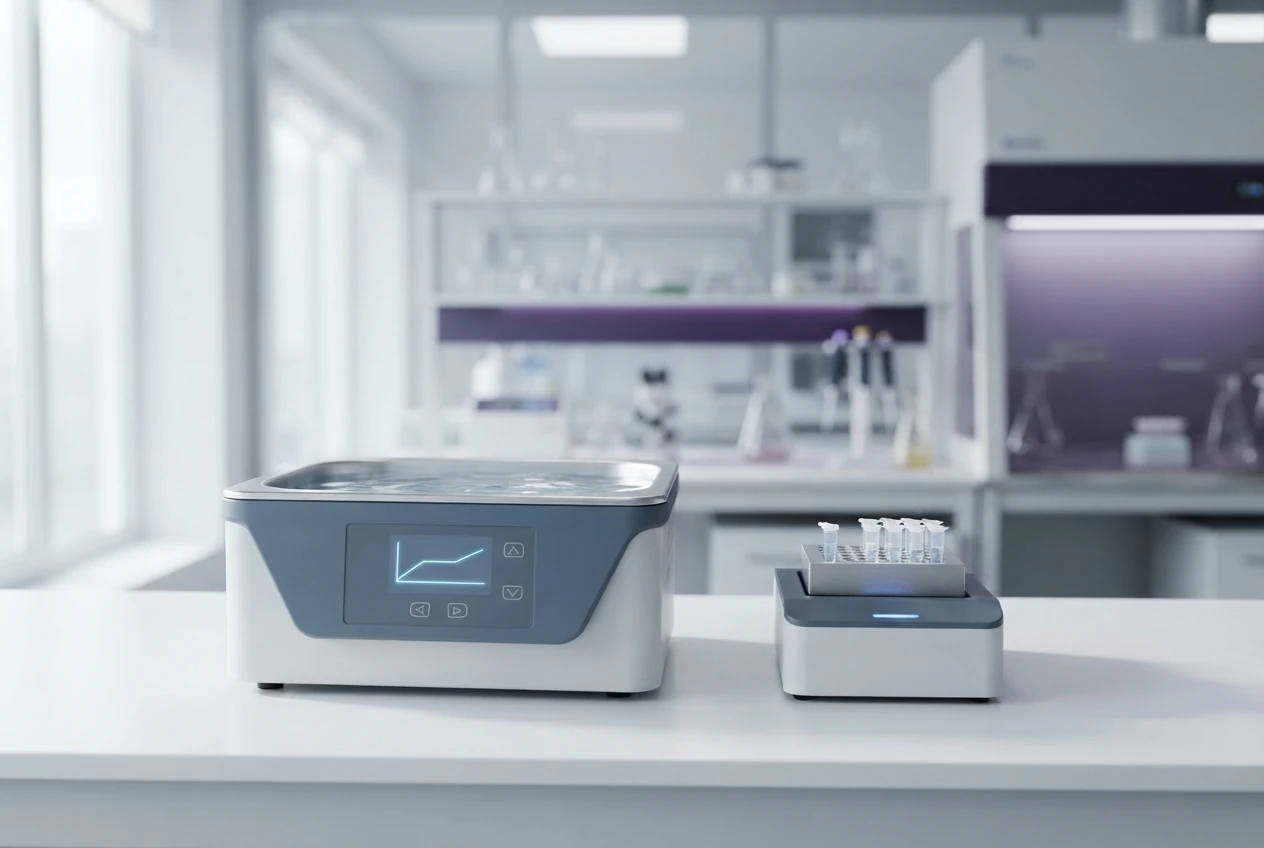
Water Baths vs Dry Baths: Which Fits Your Protocol
Water Baths vs Dry Baths: Which Fits Your Protocol
Water baths and dry baths (also called block heaters or dry block heaters) do the same basic job — hold samples at a precise, stable temperature — but they get there differently, and the difference decides which one belongs on your bench. Choosing wrong means poor thermal contact, contamination headaches, or a temperature range that will not reach your protocol. Here is how to decide.
1. Two Ways to Move Heat Into a Sample
- Water baths immerse sample vessels in temperature-controlled water. Water surrounds irregular shapes completely, so heat transfer is excellent and uniform regardless of vessel geometry. This makes water baths ideal for flasks, bottles, and mixed vessel types.
- Dry baths heat a metal block drilled with wells sized for specific tubes. Heat conducts from the block into the tube walls. There is no water to manage, warm-up is fast, and the compact footprint suits crowded benches — but thermal contact is only as good as the fit between the tube and the well.
2. Where Each One Shines
Choose a water bath when:
- You heat varied or large vessels (flasks, bottles, beakers) where a fixed block will not fit.
- You need gentle, uniform heat around an irregular shape.
- Your protocol calls for incubations at moderate temperatures where water's excellent heat transfer keeps the whole vessel even.
Choose a dry bath when:
- You work with standard microcentrifuge tubes, PCR tubes, or vials that match a block's wells.
- You want fast, spill-free heating without the maintenance and evaporation of a water bath.
- Bench space is tight or you need to avoid the contamination risk of standing water.
- You need higher temperatures than a water bath's boiling-point ceiling allows (interchangeable blocks extend both range and tube format).
3. Contamination and Maintenance
Standing water is a real trade-off. Water baths need periodic cleaning and often a biocide additive to discourage algal and microbial growth, and evaporation means topping up and watching the level. Dry baths sidestep all of this — no water, nothing to grow in, and no spills near sensitive samples or electronics. For clean, walk-up convenience, dry baths win; for versatile vessel handling, water baths are worth the upkeep.
4. Temperature Range and Uniformity
A water bath's practical upper limit sits below the boiling point of water, so protocols above that range need a dry bath (or an oil-capable circulator, a different tool). Within their range, both technologies can hold tight setpoints with a good controller. For a dry bath, uniformity depends heavily on tube-to-well fit — a loose tube has an air gap that ruins thermal contact — so match the block to your exact tube format.
5. Matching the Tool to the Task
Common protocols map cleanly onto one or the other: enzyme reactions and heat-inactivation steps in microtubes fit a dry bath; warming media, thawing, and incubating flasks fit a water bath. Many labs keep both for exactly this reason. Think about your dominant vessel format and temperature range first, then the convenience and contamination factors.
6. Throughput, Footprint, and Convenience
Beyond the science, a few workflow factors decide which unit earns its bench space:
- Capacity and format: Dry baths are rated by the number and size of wells in the block, so match the block to your tube format and batch size — and remember many accept interchangeable blocks so one base serves several tube types. Water baths are rated by internal volume and the vessels you can submerge.
- Warm-up and readiness: Dry baths reach temperature quickly and are ready to walk up to; water baths take longer to bring a volume of water to temperature but hold large thermal mass steadily once there.
- Footprint: Dry baths are compact and stack easily on crowded benches; water baths need room and a nearby water source for filling and cleaning.
- Documentation: Digital controllers with clear setpoint displays make either type easier to run reproducibly and to record for quality systems.
7. Safety and Good Practice
Both tools hold samples at temperatures that can burn, so treat hot vessels and blocks with the same care. For dry baths, use the correct tube-removal technique and tools rather than bare fingers, and keep the block clean of spilled sample. For water baths, keep the water level topped up (running dry can damage the heater), manage evaporation, and clean regularly with a biocide additive to suppress microbial growth — contaminated bath water can transfer to the outside of your vessels. Whichever you use, verify the actual temperature periodically with an independent thermometer, since a controller reading and the sample's true temperature can drift apart over time.
The Bottom Line
Water baths give you geometry-independent, uniform heat for varied vessels at the cost of upkeep; dry baths give you fast, clean, spill-free heating for standard tubes and higher temperatures. Let your vessels, temperature range, and tolerance for maintenance decide — and many labs keep one of each. Browse our thermal processing equipment, read the thermal processing buying guide, or request a quote for help choosing.