
Microplate Readers: Absorbance, Fluorescence, and Luminescence — Which Modes You Need
Microplate Readers: Absorbance, Fluorescence, and Luminescence — Which Modes You Need
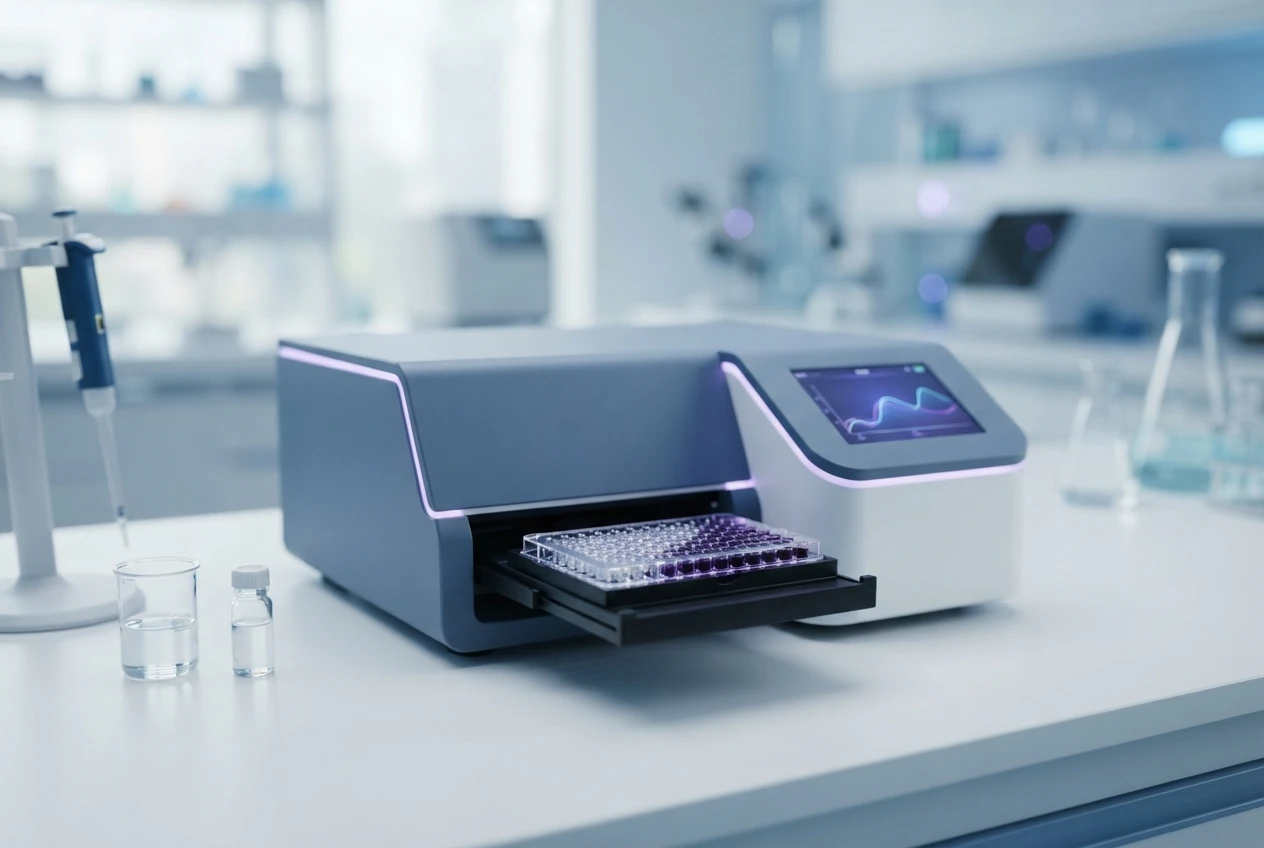
A microplate reader measures a signal from each well of a multi-well plate, letting you run many samples in parallel. What defines one reader versus another is the set of detection modes it supports — absorbance, fluorescence, and luminescence — because each mode measures a different kind of signal and suits different assays. Buying the right reader means matching those modes to the assays you actually run, without paying for capability you will never use. Here is what each mode does.
1. Absorbance — Measuring Light a Sample Absorbs
Absorbance (optical density) readers measure how much light of a given wavelength a sample absorbs as light passes through the well. It is the simplest and most common detection mode, and it underpins a huge range of routine assays:
- ELISAs using colorimetric substrates.
- Protein quantification (colorimetric assays).
- Cell viability and proliferation assays that produce a color change.
- Bacterial growth by optical density.
If your work is mostly colorimetric ELISAs and standard quantification, an absorbance reader may be all you need.
2. Fluorescence — Measuring Emitted Light
Fluorescence detection excites a fluorescent molecule with light at one wavelength and measures the light it emits at a longer wavelength. It is generally more sensitive than absorbance and enables a broad set of assays:
- Fluorescent ELISAs and immunoassays.
- Nucleic acid and protein quantification with fluorescent dyes.
- Cell-based assays using fluorescent indicators.
Fluorescence requires the reader to select excitation and emission wavelengths, which is where reader optics matter (see below).
3. Luminescence — Measuring Light a Reaction Emits
Luminescence detection measures light produced by a chemical or biological reaction itself — there is no excitation light source, so background is very low and sensitivity can be very high. It is the mode for:
- Luciferase reporter-gene assays.
- ATP-based cell viability assays.
- Luminescent immunoassays.
4. Filter-Based vs Monochromator Optics
For fluorescence (and wavelength-selective work), readers select wavelengths one of two ways:
- Filter-based readers use optical filters for specific wavelengths. They are typically very sensitive at those fixed wavelengths and cost-effective, but you are limited to the filters installed.
- Monochromator-based readers let you tune to any wavelength across a range, offering maximum flexibility for varied or evolving assays, generally at higher cost.
Choose filters for a fixed, well-defined assay menu; choose a monochromator (or a hybrid) when you need to adapt to many different assays.
5. Choosing Without Overbuying
Start from your assay list and let it dictate the modes:
- Only colorimetric ELISAs and OD? An absorbance-only reader is enough.
- Fluorescent assays too? Add fluorescence, and decide filter vs monochromator by how varied your assays are.
- Reporter-gene or ATP viability work? Include luminescence.
- A broad, growing core-facility menu? A multi-mode reader covering all three future-proofs the investment.
Also confirm plate-format support (96-well, 384-well) and any temperature control or shaking your assays require.
6. Beyond the Basic Modes
Some assays rely on detection variants layered on top of the three core modes, and if they are on your roadmap the reader has to support them from the start:
- Time-resolved fluorescence and fluorescence polarization underpin certain high-sensitivity and binding assays.
- Kinetic reads — measuring each well repeatedly over time rather than once — are essential for enzyme-rate assays, so confirm the reader can take timed, repeated measurements.
- Spectral scanning (reading across a range of wavelengths) is valuable when you are characterizing a sample rather than reading one fixed wavelength, and generally favors monochromator optics.
You do not need every capability, but knowing which advanced modes your assay pipeline will require prevents buying a reader that cannot grow with the lab.
7. Environmental Control, Software, and Throughput
The optics get the attention, but the practical fit often comes down to the surrounding features. Live-cell and enzyme assays frequently need on-board temperature control and sometimes shaking and gas control, so confirm the reader offers what your protocols demand rather than assuming ambient reads will do. Software matters more than buyers expect: the ability to define plate layouts, build standard curves, run kinetic analyses, and export data cleanly determines how much of your time the instrument saves. And think about throughput and formats — whether you run 96-well plates today but foresee 384-well work, and whether an automated plate stacker is in your future — because the reader you choose should match not just this month's assays but where the lab is heading.
The Bottom Line
A microplate reader is only as useful as the match between its detection modes and your assays. Inventory the assays first, choose the modes they demand, pick optics to fit how fixed or flexible your menu is, and confirm the environmental control, software, and plate formats your work needs. Explore our life science equipment, read the life science buying guide, or request a quote for help specifying a reader.