
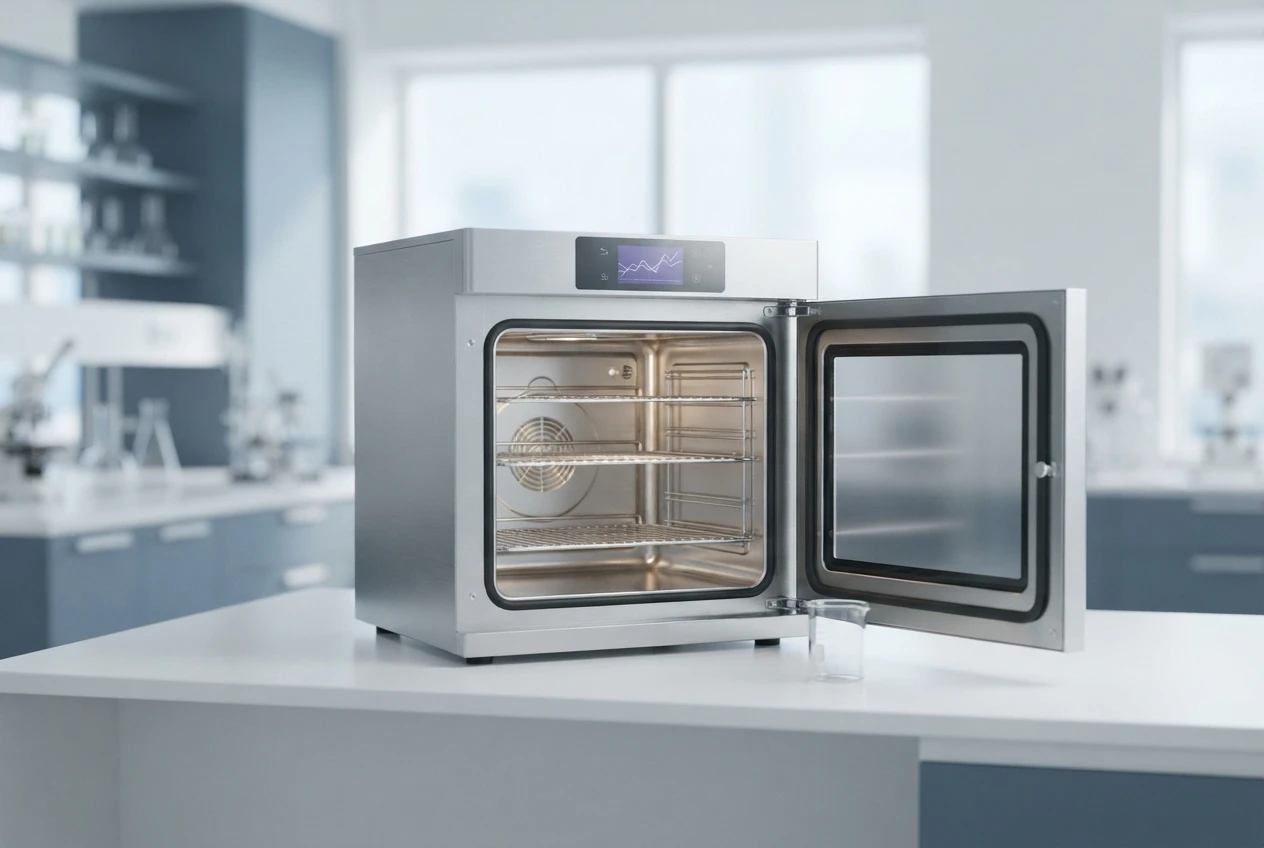
Choosing a Laboratory Oven: Gravity vs Forced-Air Convection
Choosing a Laboratory Oven: Gravity vs Forced-Air Convection
A laboratory oven looks simple next to the instruments around it, but the way it moves heat determines whether your samples dry evenly, whether the temperature holds after you open the door, and how long a batch takes. The single most important decision is the convection type: gravity (natural) convection versus mechanical forced-air convection. This guide explains the difference and how to match an oven to your work.
1. How the Two Convection Types Work
Both oven types heat the chamber with an electric element; they differ in how that heat is distributed:
- Gravity (natural) convection relies on the physics that warm air rises and cool air falls. Air circulates on its own, gently and without a fan. Because there is no forced air movement, gravity ovens are quiet, have fewer moving parts, and do not disturb lightweight samples.
- Forced-air (mechanical) convection uses a fan or blower to actively push heated air around the chamber. This produces more uniform temperatures, faster heat-up, and quicker recovery after the door is opened.
2. Temperature Uniformity and Recovery — Where Forced-Air Wins
Two specifications describe how evenly and reliably an oven heats: uniformity (how close every point in the chamber is to the setpoint at a given moment) and recovery (how quickly the chamber returns to setpoint after the door opens). Forced-air ovens generally deliver tighter uniformity and faster recovery because the fan eliminates the hot and cool pockets that natural convection leaves behind. If your protocol requires the whole load to sit within a narrow band of the setpoint — most drying, curing, and reproducible heat-treatment work — forced-air is the safer choice.
3. When Gravity Convection Is the Better Fit
Gravity convection is not merely the budget option; it is the correct option for certain work. Because there is no fan-driven airflow, gravity ovens are preferred when moving air would be a problem:
- Light or powdery samples that a fan could scatter or cross-contaminate.
- Slow, gentle drying where you want moisture to leave gradually rather than forming a dried skin on the surface.
- Applications sensitive to particulate disturbance, where still air keeps samples undisturbed.
The trade-off is longer heat-up times and less uniform temperatures, which matter less for these applications.
4. Match the Oven to the Protocol
Before comparing models, define what you are actually doing:
- Drying glassware or evaporating solvent? Forced-air moves moisture-laden air out faster and dries more evenly.
- Gravimetric or loss-on-drying analysis? Uniformity matters most; forced-air gives repeatable results, but confirm the airflow will not disturb your sample mass.
- Sterilizing or depyrogenation at higher temperatures? Confirm the oven's rated maximum temperature covers your protocol with margin.
- Curing, annealing, or general heat treatment? Tight uniformity from forced-air keeps a batch consistent.
5. Practical Factors That Round Out the Decision
- Temperature range: Ovens typically top out well below furnace territory — confirm the maximum meets your needs, and remember a muffle furnace, not an oven, is the tool for very high-temperature ashing and ignition.
- Capacity vs footprint: Size the chamber to your real batch volume and shelf layout, not the largest available.
- Controls and documentation: Digital controllers, over-temperature protection, and data output support compliance and repeatability.
- Ventilation: If you evaporate solvent or drive off moisture, adjustable dampers or an exhaust port help control the atmosphere.
6. Loading and Placement Shape Real-World Uniformity
A published uniformity figure is measured in an empty, correctly installed chamber — your day-to-day results depend on how you use it. A few habits protect the uniformity you paid for:
- Do not overload. Packing shelves tightly blocks airflow and creates cold spots. Leave space around samples and between the load and the walls so air can circulate.
- Distribute the load evenly rather than stacking everything on one shelf, and avoid covering the air inlets and outlets.
- Give the chamber time to stabilize after loading and after every door opening before you start timing a temperature-critical step — recovery is not instant even on a forced-air unit.
- Place the oven thoughtfully: away from drafts, direct sun, and other heat sources, with clearance for ventilation, so the ambient environment does not fight the controller.
For any quantitative work, it is also good practice to verify chamber performance periodically with an independent calibrated sensor rather than trusting the display alone — the reading on the panel and the temperature your sample experiences can differ, especially near the door and corners.
7. Oven or Furnace? Know the Boundary
It is worth being clear about where an oven's job ends. Laboratory ovens are built for the drying, curing, and moderate heat-treatment range. When a method calls for the very high temperatures used to burn a sample down to ash or ignite off volatile content, that is furnace territory, not oven territory — using an oven at temperatures it was never rated for is both ineffective and unsafe. If your work spans both regimes, plan for the right tool at each end rather than pushing one instrument past its design range.
The Bottom Line
Choose forced-air convection when uniformity, speed, and recovery matter — the majority of drying and heat-treatment work. Choose gravity convection when still air protects delicate or powdery samples. Define the protocol first, then let the airflow requirement point you at the right class, and load and site the oven so it can actually deliver its rated performance. Explore our thermal processing equipment, read the full thermal processing buying guide, or request a quote and our team will help you spec the right oven.