
Homogenizers and Cell Lysis: Bead Mill vs Rotor-Stator vs Sonication
Homogenizers and Cell Lysis: Bead Mill vs Rotor-Stator vs Sonication
Most downstream work — extracting DNA, RNA, or protein — starts with getting inside the cell. Disrupting cells and tissue is largely a mechanical problem, and the three most common instruments approach it very differently. The right method depends on your sample type, how tough it is to break, what you want to recover, and how many samples you process. Here is how bead mills, rotor-stators, and sonicators compare.
1. Bead Mills (Bead Beating)
A bead mill agitates the sample with small, dense beads at high speed inside a tube. The collisions physically grind and shear cells and tissue apart. Bead beating is versatile and especially strong on tough, hard-to-lyse samples:
- Microorganisms with tough cell walls — bacteria, yeast, fungi, spores.
- Fibrous or hard tissue and plant material.
- High-throughput processing, since many tubes (or plates) can be beaten in parallel.
Bead selection (size and material) is matched to the sample, and because the tube is closed, cross-contamination risk is low and containment is good. Heat can build up during beating, so cooling between cycles protects sensitive molecules.
2. Rotor-Stator Homogenizers
A rotor-stator homogenizer uses a fast-spinning rotor inside a fixed stator; the sample is drawn through the narrow gap between them and sheared apart. It excels at reducing soft-to-moderate tissue to a uniform homogenate quickly:
- Animal tissues — liver, muscle, brain, and similar.
- Producing smooth, uniform homogenates for extraction.
- Flexible volumes, since probes come in different sizes for small tubes up to larger vessels.
The probe contacts the sample directly, so it must be cleaned thoroughly between samples to avoid carryover — a key consideration for high sample numbers or trace work.
3. Sonication (Ultrasonic Disruption)
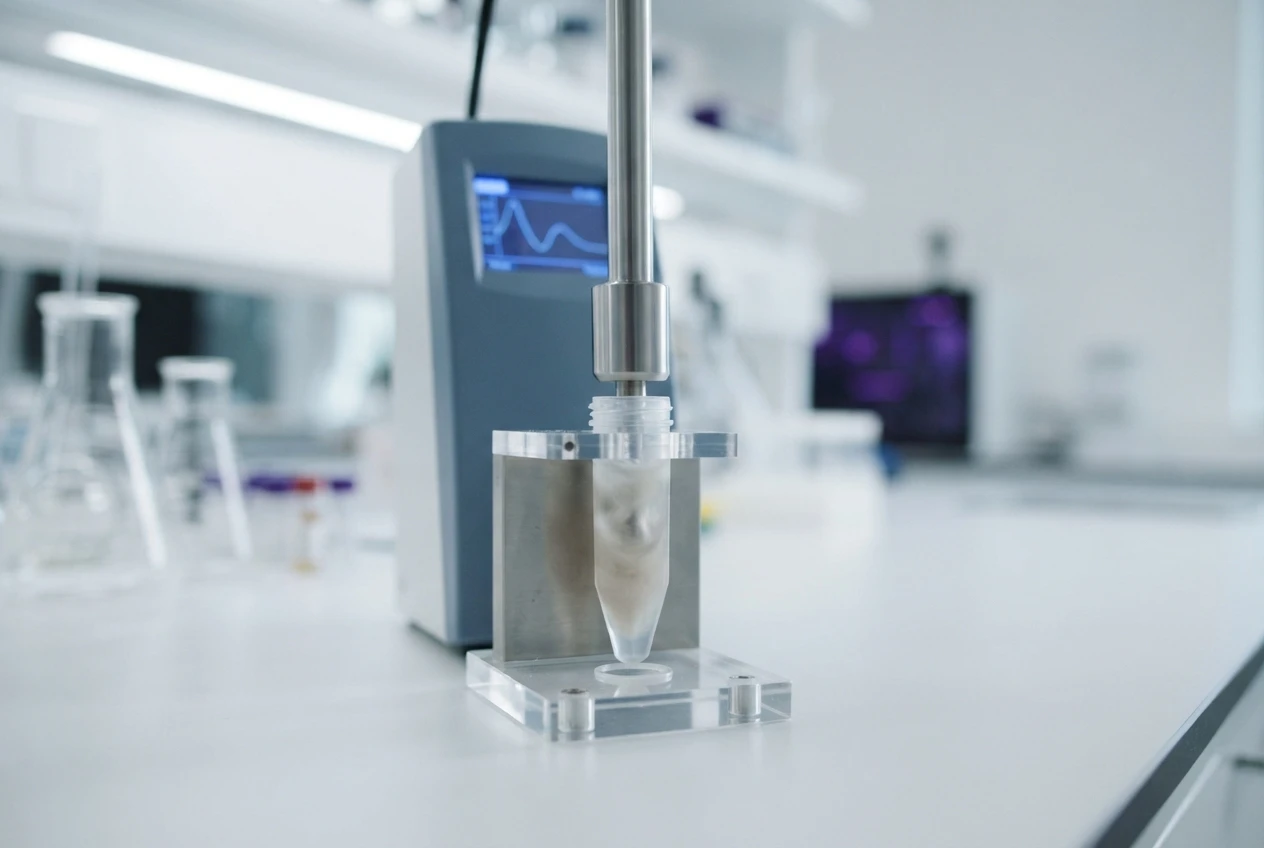
Sonication uses high-frequency sound waves to create cavitation — imploding microbubbles whose shear forces rupture cells. It is widely used for cell suspensions and has a useful side benefit in shearing nucleic acids:
- Lysing bacterial and mammalian cell suspensions.
- Shearing DNA or chromatin to defined fragment sizes (for example in library prep or ChIP).
- Emulsifying and dispersing.
Sonication generates significant heat, so samples are kept on ice and pulsed rather than run continuously. A probe sonicator contacts the sample (clean between runs); some formats avoid direct contact for better containment.
4. Choosing the Right Method
Match the disruption method to four questions:
- How tough is the sample? Tough-walled microbes and fibrous tissue favor bead milling; soft tissue favors a rotor-stator; cell suspensions favor sonication or bead milling.
- What are you recovering? Heat-sensitive proteins and RNA need methods with good temperature control (cooling, pulsing); if you also need sheared DNA, sonication does double duty.
- How many samples? Bead mills shine for high-throughput parallel processing; rotor-stators and probe sonicators are typically one sample at a time with cleaning between.
- Containment matters? Closed-tube bead beating minimizes aerosols and cross-contamination.
Whatever the method, reproducibility comes from controlling temperature and keeping the disruption conditions consistent from sample to sample.
5. Protecting Your Target Molecule
Disruption is a means to an end — intact DNA, RNA, or active protein — and the mechanical energy that breaks cells can also damage what you are trying to recover. Two forces do the harm: heat and shear. All three methods generate heat, and sonication especially so, which is why heat-sensitive work is done on ice and in pulses with cooling pauses rather than in one continuous run. Shear is the other consideration: it is exactly what shears DNA to fragments during sonication (useful when you want that, harmful when you want intact high-molecular-weight DNA). For labile proteins, keep everything cold, add the appropriate protease inhibitors and lysis buffer, and choose the gentlest method that still fully lyses your sample. The right answer balances complete disruption against preserving the molecule — over-processing can cost you as much yield as under-processing.
6. Cross-Contamination, Consumables, and Reproducibility
How a method handles many samples shapes both data quality and running cost:
- Cross-contamination: closed-tube bead beating keeps each sample sealed, minimizing carryover and aerosols. Contact methods — rotor-stator probes and probe sonicators — touch the sample directly and must be cleaned thoroughly between samples, which is a real time cost and a contamination risk in trace or high-sensitivity work.
- Consumables: bead mills need the right beads (and often single-use tubes) matched to the sample; factor these into per-sample cost and throughput.
- Reproducibility: whichever method you use, hold the conditions constant — the same time, intensity, bead type, cooling regime, and buffer — so results compare from sample to sample and run to run.
The Bottom Line
Bead mills brute-force tough samples at high throughput, rotor-stators quickly homogenize soft tissue, and sonication lyses suspensions while shearing nucleic acids. Let sample toughness, your target molecule, throughput, and contamination control decide — and keep conditions consistent for reproducible results. Explore our life science equipment, read the life science buying guide, or request a quote for help choosing a homogenizer.