
The Complete Centrifuge Buying Guide: Rotors, RCF, and Choosing the Right Model
The Complete Centrifuge Buying Guide: Rotors, RCF, and Choosing the Right Model
A centrifuge is one of the hardest-working instruments in any lab — and one of the easiest to buy wrong. Choosing based on top speed alone ignores the two factors that actually determine whether a unit fits your work: the rotor it accepts and the relative centrifugal force (RCF) it can deliver to your samples. This guide walks through how to match a centrifuge to your samples, throughput, and bench space.
1. Start With the Sample, Not the Spec Sheet
Before comparing models, define what you are actually spinning: tube size and count, sample volume, and the separation you need (pelleting cells, clarifying lysate, separating plasma, or PCR spin-downs). These answers point you straight at a class of instrument:
- Microcentrifuges — 1.5–2.0 mL tubes, high speed, small footprint. The workhorse for molecular biology.
- Clinical / benchtop centrifuges — blood tubes and mid-volume samples for diagnostics and general prep.
- Refrigerated centrifuges — temperature-sensitive samples (proteins, live cells) that degrade at ambient spin temperatures.
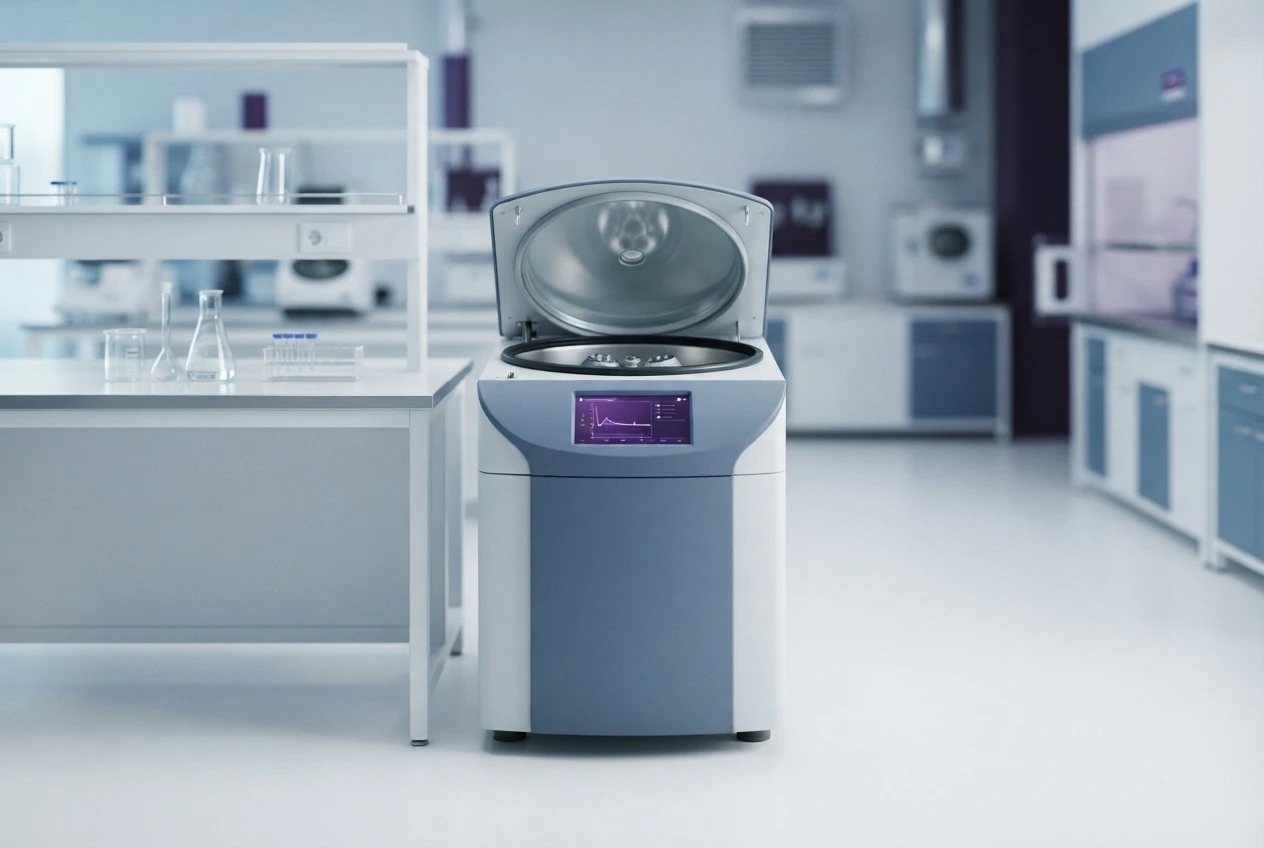
- Floor-standing / high-capacity centrifuges — bulk throughput and large-bottle work where bench units run out of room.
Browse the full range across these classes in our centrifuges category.
2. RCF vs RPM — Why the Distinction Matters
Manufacturers advertise RPM (revolutions per minute), but protocols specify RCF (relative centrifugal force, expressed as × g). They are not interchangeable: the same RPM produces very different force depending on the rotor's radius. Two centrifuges both rated "15,000 RPM" can deliver meaningfully different g-force to your sample.
Always convert your protocol's required RCF to the RPM for your specific rotor before you spin — our free RCF ⇄ RPM calculator does the conversion for you. We cover this in depth in RCF vs RPM: What Every Lab Needs to Know.
3. Fixed-Angle vs Swing-Bucket Rotors
The rotor is where the science happens, and most centrifuges accept more than one type:
- Fixed-angle rotors hold tubes at a set angle, produce a compact pellet against the tube wall, and reach higher speeds — ideal for pelleting cells and precipitating nucleic acids.
- Swing-bucket rotors let tubes swing horizontal during the spin, giving a flat, well-separated pellet and clean phase boundaries — better for density gradients and blood separations.
Confirm which rotors a model supports, and whether they are included or sold separately, before you commit.
4. Refrigeration, Capacity, and Duty Cycle
Three practical factors round out the decision:
- Refrigeration: If you work with live cells or heat-labile proteins, a refrigerated unit that holds 4 °C during long spins protects sample integrity.
- Capacity vs footprint: Match tube-count throughput to your actual batch sizes — over-buying capacity wastes bench space and budget.
- Duty cycle and noise: High-throughput labs should confirm a unit is rated for continuous use, not just intermittent spins.
5. Don't Forget Safety and Balance
Every centrifuge must be loaded in balanced pairs, and lid-interlock and imbalance-detection features are non-negotiable for operator safety. Look for automatic rotor recognition and imbalance shutoff on any model you consider.
Ready to Choose?
The right centrifuge is the one matched to your samples, your required RCF, and your throughput — not simply the one with the highest RPM. Explore our centrifuge range, run your numbers through the RCF calculator, or request a quote and our team will help you spec the right unit.