
Biological Safety Cabinets Explained: Class I, II, and III
Biological Safety Cabinets Explained: Class I, II, and III
"Biosafety cabinet" is often used as a catch-all, but the three classes protect very different things — and choosing the wrong one can put either your samples or your staff at risk. Here is a clear breakdown of what each class does and how to match one to your work.
First: A BSC Is Not a Laminar Flow Hood
This is the most important — and most common — mistake. A laminar flow (clean bench) hood blows filtered air toward the operator to protect the sample, and offers no personnel protection. It must never be used with infectious, toxic, or sensitizing material. A biological safety cabinet (BSC) is engineered to protect the operator (and often the environment and sample) from biohazards. If you are working with anything infectious, you need a BSC, not a clean bench.
Class I — Personnel and Environment Protection
A Class I cabinet draws room air inward across the work surface and exhausts it through a HEPA filter, protecting the operator and environment — but not the sample, since unfiltered room air passes over the work. It suits containment of equipment (like centrifuges) or procedures where sample sterility is not the concern.
Class II — Personnel, Environment, and Sample Protection
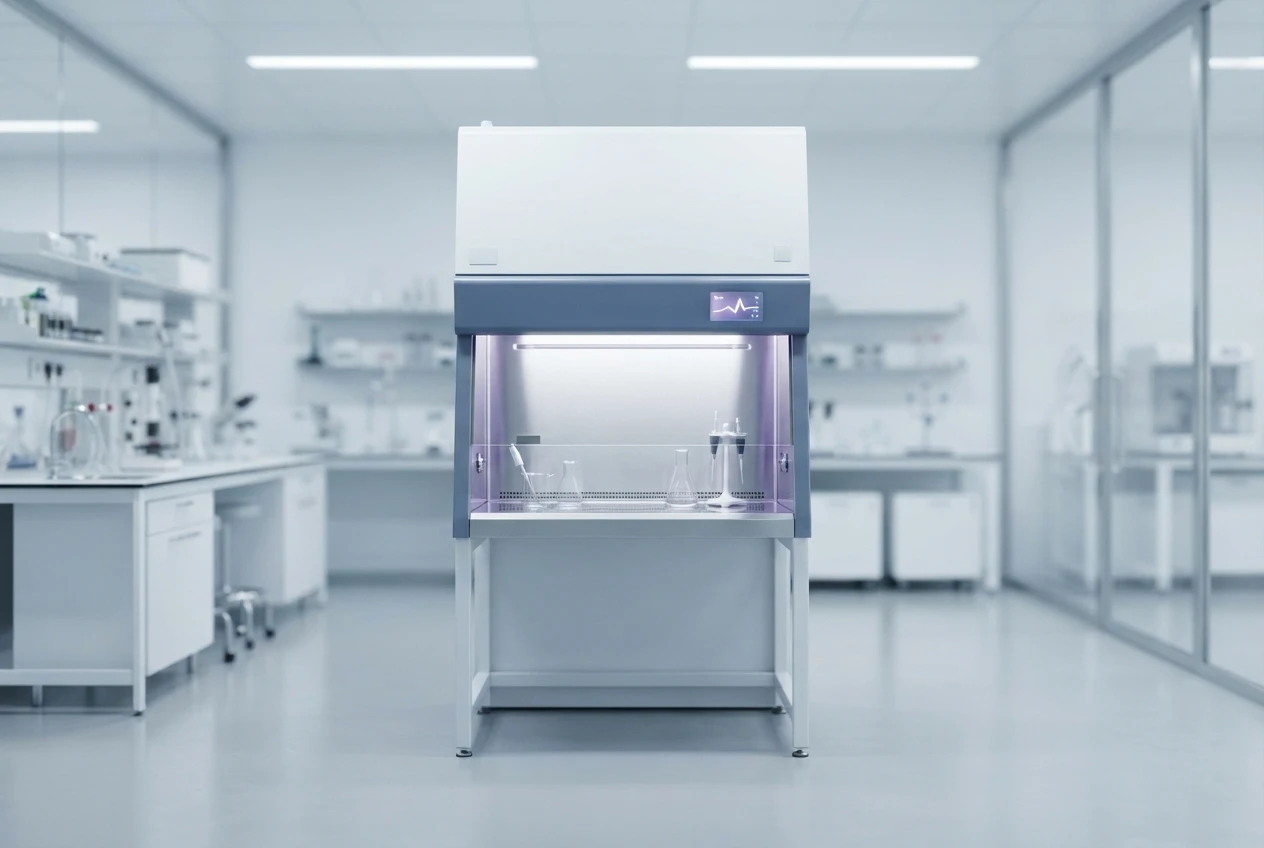
The most widely used type in life-science and clinical labs, a Class II cabinet adds product protection: HEPA-filtered air flows down over the work surface (protecting the sample) while an inward air curtain protects the operator, and HEPA-filtered exhaust protects the environment. Class II is subdivided by airflow and exhaust design:
- Type A2 — the general-purpose standard; recirculates most air, exhausts through HEPA. Suits work with biological agents without volatile chemicals.
- Type B2 (total exhaust) — ducts all air outside, supporting work that involves volatile toxic chemicals or radionuclides.
Choosing between them comes down to whether your protocols involve hazardous volatile chemicals in addition to biological agents.
Class III — Maximum Containment
A Class III cabinet is a fully sealed, gas-tight glovebox for the highest-risk agents (BSL-4). The operator works through attached gloves and never has direct contact with the interior. Unless you are running a maximum-containment facility, this is not the class you need.
How to Choose
- Do you need to protect the sample? If yes (most cell-culture and sterile work), you need at least Class II.
- Do your protocols use volatile toxic chemicals? If yes, look at Class II Type B2 total-exhaust.
- Working with high-risk agents? Class III, integrated into a containment suite.
- Only protecting the product, no biohazard? A laminar flow clean bench may be appropriate — but never for infectious material.
Get It Right the First Time
The class you need is dictated by your protocols and your agents, not by budget. Explore our safety & care equipment, and request a quote for help matching a cabinet to your biosafety level and workflow.